
ARE WE MORE IMPRISONED THAN EVER AND DO WE EVEN KNOW IT?
By: Realistiqthinker
I have sat with Maasai elders in the Trans Mara, in Kenya’s borderland where the savannah rolls toward Tanzania and the sky feels wider than anywhere else, I have known. I have shared food in Karamojong homesteads in northeastern Uganda, where cattle are not merely livestock but the living currency of dignity and kinship. I have listened to Pokot men and women in Turkana speak about land in a way that makes every GPS coordinate feel like a cruel reduction. I have walked through communities in the Acholi subregion of northern Uganda; communities that endured more than twenty years of war, whose children were taken in the night, whose villages were emptied, and whose recovery no dataset has ever fully captured. And in Hyderabad, in southern Pakistan, I have worked alongside Pachauri and Kachikoli communities; minority groups and tribal peoples dismissed by the wider society with a single word: tribal. As if a word could contain what centuries of marginalisation have produced.
I have carried these people with me into every conversation about artificial intelligence and digital development. Because here is what I know from fieldwork that no literature review can teach: the communities most targeted by algorithmic governance systems are almost always the communities least visible to the people who build them. And when a system cannot see you fully, it does not leave you alone. It classifies you anyway and the classification follows you.
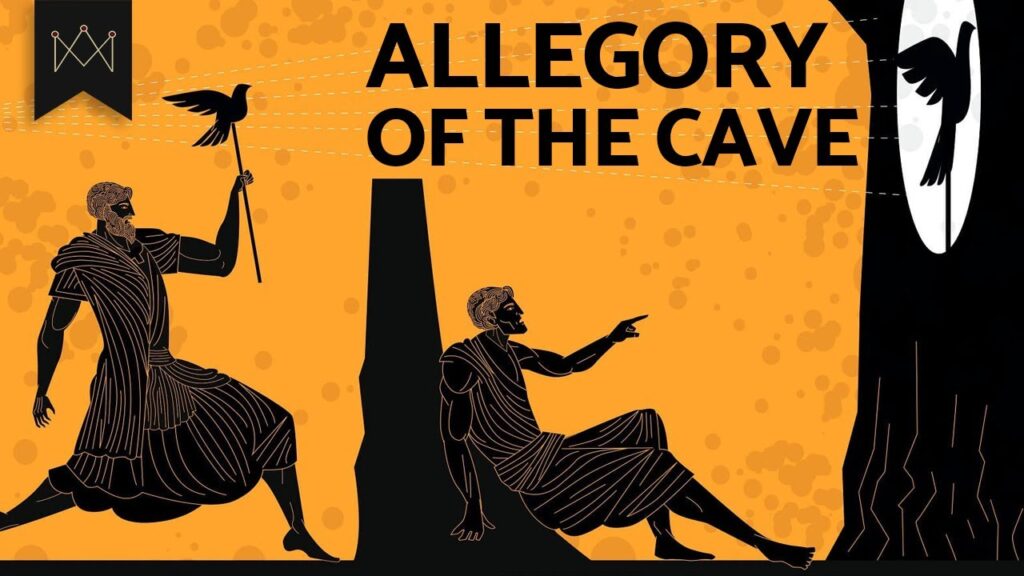
This is what Plato described, more than two thousand years ago, as the condition of the prisoners in the cave.
“The shadows are the only truth the prisoners know. To challenge the shadow is to challenge everything they are.”
-Plato, The Republic, Book VII (paraphrase)
The allegory that refuses to age
In Plato’s allegory, prisoners are chained inside a dark cave, facing a wall. A fire burns behind them. Objects pass between the fire and the prisoners, casting shadows on the wall ahead. The prisoners have known nothing else, so they take the shadows for reality. When one prisoner is freed and dragged into the sunlight, the truth is overwhelming and at first, unbearable. When he returns to tell the others, they threaten him. The shadow is all they trust.
I read this not as ancient myth but as a precise description of what algorithmic systems do to human communities. The model is the shadow. The person is the thing casting it. And the tragedy of our moment is that we have built institutions; governments, aid organisations, development programmes that increasingly govern people by their shadows while the people themselves remain unseen.
The cave, in our age, has been rebuilt with fibre optic cable and cloud infrastructure. And unlike Plato’s original, this cave is personalised. The shadows you see are tailored to your prior behaviour. The algorithm knows what will hold your attention, what will confirm your assumptions, what will keep you facing the wall. It does not ask what is true. It asks what is engaging. And because engagement and truth are not the same thing, the world, the algorithm shows you is by design, a curated distortion.
When the shadow governs a life
Among the Acholi in northern Uganda, I encountered something that has stayed with me since. International development organisations, years after the LRA conflict had ended and displacement camps had finally emptied, were still operating with data profiles built during the war. Humanitarian needs assessments from crisis years later were shaping resource allocation decision, however fragile, a post-conflict recovery context. The communities had changed. The shadow had not.
The Karamojong in northeastern Uganda face a version of this continuously. Their way of life, semi-nomadic, cattle-centred, deeply relational; resists the categories that data systems require. When a mobile needs-assessment survey asks whether a household has a “permanent structure,” the Karamojong homestead fails the test. When it asks about formal income, the answer is silence. The result is a profile that reads as deprivation where there is, in fact, a complex and functioning social economy; one that simply does not speak the language the algorithm was trained to hear. The shadow says: poor, vulnerable, high-risk. The reality is: different, and therefore illegible.
In Trans Mara and Kajiado, I saw Maasai communities navigating land tenure digitalisation programmes that GIS-mapped their grazing corridors and assigned coordinates to movement patterns that had existed for generations. The maps looked authoritative. They were presented to donors as evidence of systematic, data-driven resource management. What they did not show what they could not show, was the seasonal logic, the inter-clan negotiation, the oral geography embedded in cattle trails and waterhole names. The map was the shadow. The land was something far more alive.
And in Hyderabad, working with Pachauri and Kachikoli communities in what outsiders call Pakistan’s “tribal areas,” I encountered the accumulated weight of being classified before you are heard. These communities carry a label tribal that functions as a verdict. Welfare systems, security assessments, and development programmes read the label first. The person comes second, if at all. An AI-assisted targeting system does not challenge this hierarchy. It inherits it, encodes it, and scales it, at a speed and confidence level that makes the original prejudice look restrained by comparison.
The Pattern Across Every Context
Whether in Turkana or Trans Mara, in Acholi or in Hyderabad, the pattern holds. The communities with the deepest histories, the most complex social architectures, and the greatest need for accurate representation are the ones most likely to be flattened into a profile, misread by a model, and governed by a shadow that bears only a passing resemblance to who they actually are.
The prisoner who refuses to leave the wall
There is a detail in Plato’s allegory I find most haunting. When the freed prisoner returns to warn the others, they do not welcome him. They resist. The shadow is their reality, and the man who questions it threatens everything they know. I meet this resistance regularly, not among the communities I have described, who tend to know very well when a system has misread them, but among the institutions operating those systems.
When I raise questions about what is lost when a scoring model replaces a community conversation, the response is often defensive. The algorithm is more objective than a person, I am told. Data does not discriminate. Scale demands efficiency. These are the shadows speaking, and they speak with great institutional confidence. The problem is that objectivity is not the same as truth. A model trained on historically biased data does not transcend that bias. It reproduces it at speed. The shadow is consistent. The shadow is measurable. The shadow is not the person.
What turning toward the light actually demands
Plato’s freed prisoner does not walk into the sunlight and immediately feel better. His eyes, accustomed to darkness, cannot at first bear the brightness. Truth is disorienting before it is liberating. The journey toward it is slow, uncomfortable, and requires the willingness to have everything you were certain of called into question.
I think about this whenever someone asks me what responsible AI in development contexts should look like. My answer is not a framework or a checklist. It is a disposition. It is the willingness to sit in a Karamojong homestead and let the complexity of that life challenge the confidence of your model. To walk with a Pokot woman through Turkana and understand that her relationship to land cannot be captured in a coordinate. To listen to an Acholi elder, describe twenty years of war and recognise that no needs-assessment tool was built to hold that kind of knowledge.
That is what turning toward the light looks like in practice. It is proximity. It is slowness. It is the institutional courage to say even when it is costly, that the shadow is not the person, and that the person must be encountered directly before they can be served honestly.
Plato called this philosophy. I call it the bare minimum that human dignity requires. And I believe it is the question that every system claiming to serve vulnerable communities must be made to answer, not in a policy document, but in practice, on the ground, in the places where the shadows are cast longest and the people behind them are most consistently unseen.
The chains, after all, are most effective when the prisoner has forgotten they are there and most dangerous when the jailer has convinced themselves they are doing good.
About the Author
Realistiqthinker
Realistiqthinker is an independent thinker and writer with a background in philosophical and ethical studies, theological ethics, and international development. He holds a Certified Monitoring and Evaluation Professional qualification and has completed studies in Artificial Intelligence. His fieldwork experience spans community development contexts in Pakistan and East Africa. He writes at the intersection of philosophy, human dignity, social justice and emerging technology asking the questions that our increasingly automated world urgently needs to face.