
The Ancient Philosophy of Inner Freedom and Why It May Be the Most Radical Act Available to Us Right Now
By Realistiqthinker
Marcus Aurelius governed the Roman Empire at one of its most complex and violent peaks. He commanded armies, navigated political betrayal, buried children, and endured plague. And yet, the document he left behind is not a manual of conquest.
It is a private journal.
A record of a man trying, each day, to distinguish what he could control from what he could not, and to act with integrity within that boundary.
He never intended to publish Meditations. He wrote it for himself. That is precisely why it has endured for nearly two thousand years.
I find myself returning to that discipline often. Because we are living through a moment that demands exactly the same clarity: the ability to face a force reshaping the world and ask, without panic and without illusion,
What here is mine to act on? What is not? And what does wisdom look like in the space between?
Artificial intelligence is now that force.
The Moment We Are In
AI is entering our institutions, our economies, and our private lives at a speed that outpaces our ability to understand it. Public conversation tends to collapse into two extremes: uncritical enthusiasm or catastrophic fear.
The Stoics offer something rarer, and more useful.
They offer a way to remain human inside a transformation you did not entirely choose. More importantly, they remind us that real agency has always lived in one place: the interior life.
But this is not just philosophical theory.
Because in many of the communities I have worked with, places the technology industry rarely studies with honesty, I have seen something recognisably Stoic long before it became fashionable language.
The Dichotomy of Control and Who Already Lives It
The foundation of Stoicism comes from Epictetus, a man who understood powerlessness intimately. Born into slavery, he developed one of the most rigorous philosophies of inner freedom in human history.
His principle is simple:
Some things are in our power. Some are not.
Our judgments, desires, and responses, these are ours.
Reputation, wealth, systems, and the actions of others, these are not.
To confuse the two is the beginning of suffering.
Now consider artificial intelligence.
It increasingly operates in the domain of what is not in our control: hiring algorithms that filter candidates before a human sees them, credit systems that define risk before a conversation begins, content feeds that shape perception before reflection occurs.
The Stoic response is not denial. Nor is it rage.
It is precision.
What remains mine? What can I still choose?
And more importantly: how do I strengthen that inner ground so that no system, however advanced, can take possession of it?
In Turkana, among the Pokot communities of Kenya, I witnessed something deeply Stoic without the language of philosophy. These communities live with real external constraints, scarcity, contested land, and growing digital pressures.
Yet their decision-making was deliberate. Speech was measured. Elders consistently distinguished between what could be acted upon and what had to be endured.
That is not passivity.
That is discipline.
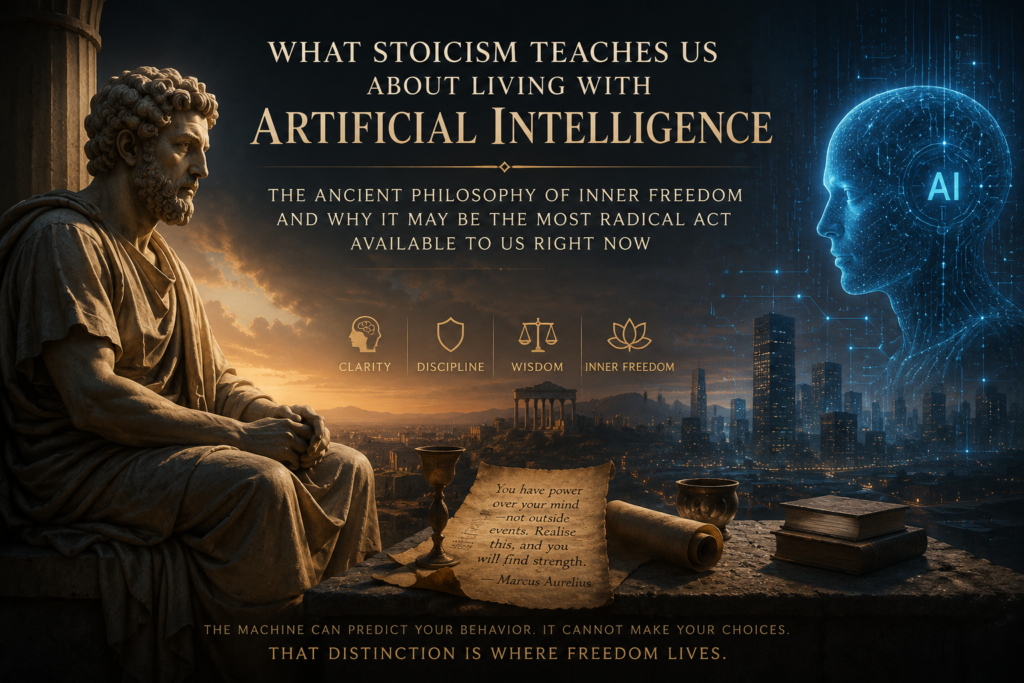
“You have power over your mind, not outside events. Realise this, and you will find strength.”
Marcus Aurelius
Amor Fati, Not Surrender, But Alignment
Stoicism teaches amor fati, the love of fate.
This is often misunderstood as passive acceptance. It is not.
It is an active decision to stop resisting reality as it is and to begin working intelligently within it.
In the AI conversation, this distinction matters.
There are voices insisting that artificial intelligence should not exist, that it should be reversed or halted entirely. The impulse is understandable. I have seen firsthand how flawed systems harm vulnerable communities from misclassified welfare data in Uganda to biased algorithmic judgments in Hyderabad.
The anger is justified.
But the Stoic insight is sharper: expending energy resisting what cannot be undone weakens the very agency we still possess.
AI is not going away.
So, the better question becomes:
Given that this force exists, what is the most human response available to us?
How do we build forms of strength that no algorithm can replicate?
Premeditatio Malorum, Thinking Clearly Before Crisis Arrives
The Stoics practiced something called premeditatio malorum, the premeditation of adversity.
Each day, they imagined potential difficulties, not to become pessimistic, but to become prepared.
This may be the most practical Stoic tool for the AI age and one we are almost entirely neglecting.
Technology conversations tend toward optimism or panic. Rarely do they offer grounded foresight.
But what if we asked, calmly and clearly:
What happens when a biased credit model evaluates a farmer whose history exists outside formal data?
What happens when predictive policing is trained on already discriminatory patterns?
What happens when recommendation systems shape the mind of a young person still processing trauma?
To name these risks before they unfold is not negativity.
It is responsibility.
It is how harm is prevented, before it becomes invisible and systemic.
A Stoic Standard for Technology
Epictetus asked of life: Is this within my control?
We might ask of technology:
Does this system expand or diminish human freedom?
Does it strengthen a person’s ability to think, choose, and act?
Or does it quietly replace judgment with automation, agency with prediction, dignity with data?
A system that strengthens inner freedom serves humanity.
One that weakens it does not.
The Inner Citadel Is a Practice
Marcus Aurelius described something he called the inner citadel, a place within a person that no external force could breach without consent.
This was not poetic language. It was discipline.
The citadel is not built once. It is maintained daily, through reflection, self-examination, and conscious choice.
And this is where Stoicism speaks most powerfully to our moment.
Not with rejection of technology.
Not with blind acceptance.
But with practice.
The quiet, consistent act of remaining the author of your own attention.
To choose what you consume, and why.
To question the values embedded in the tools you use.
To pause before accepting an algorithm’s conclusion and ask: Is this judgment mine?
A Wisdom Older Than Our Technology
In Maasai communities in Trans Mara, I observed an early morning practice, an unhurried stillness before the demands of the day.
It was not framed as “mindfulness.” It was orientation.
A deliberate placing of the self within a larger order before the noise begins.
I do not know what name they would give it.
But I recognised it.
Marcus Aurelius did the same thing, alone, in a tent, at the edge of empire.
Separated by centuries, they shared the same understanding:
The greatest danger of any powerful external force, whether empire, plague, or algorithm—is not what it does to your circumstances.
It is what it does to your inner life, if you allow it.
The Freedom That Remains
The Stoic answer is simple, but not easy:
Do not allow it.
Build the citadel. Maintain it. Act from it.
Because in the end, there is one boundary technology cannot cross without your permission:
It can predict your behavior.
But it cannot make your choices.
And in that quiet, stubborn space
Freedom still lives.
About the Author
Realistiqthinker is an independent writer and thinker working at the intersection of philosophy, human dignity, social justice, and emerging technology. He holds a Certified Monitoring and Evaluation Professional qualification and has completed studies in Artificial Intelligence. His fieldwork spans community development contexts in Pakistan and East Africa, where he examines how global systems impact local realities. His writing challenges inherited assumptions and asks the deeper ethical questions shaping an increasingly automated world.