
By Realistiq Thinker
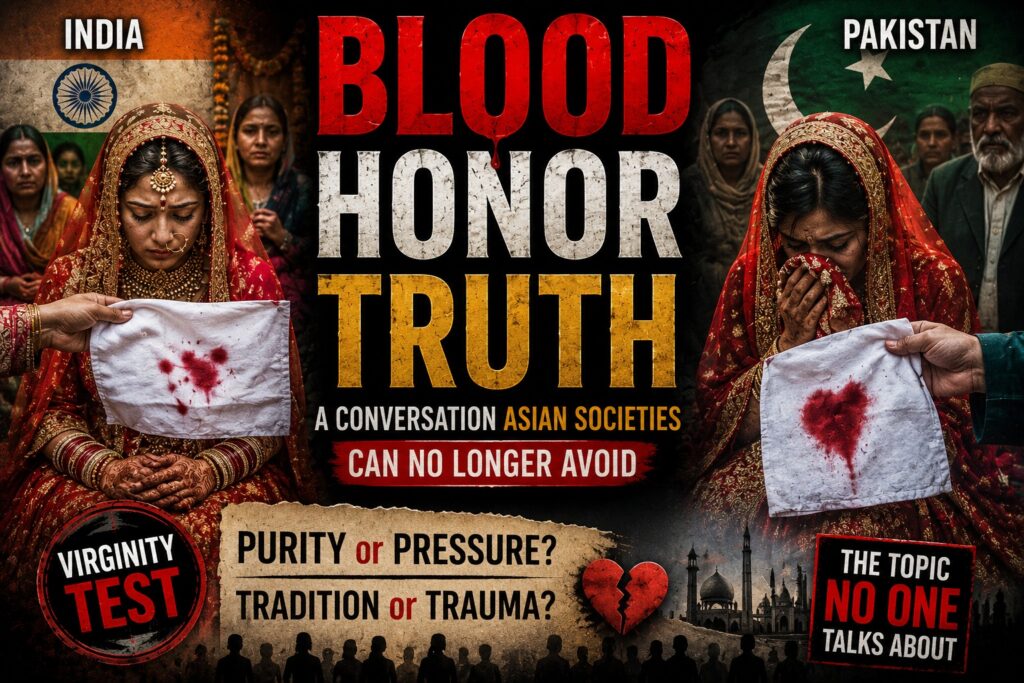
There is a question that follows a young woman into her wedding night, long before anyone says it out loud.
It sits quietly in the room with her. It lingers in the folded hands of relatives waiting outside the door. It lives inside a silence that has already decided what it wants to hear.
Will she bleed?
I have sat across from people who carried the weight of that question for years after their wedding night ended. I have witnessed what happens to a marriage and to a human soul when a stain on a bedsheet is treated as evidence of character.
This is not an abstract argument. It comes from real rooms, real conversations, and real damage where shame has done what even violence could not fully accomplish.
If this makes you uncomfortable, stay with it. Because discomfort is often the first sign that we are approaching something true.
Understanding the Belief Before We Dismantle It
To begin with, it is easy to mock a belief once we have decided it is wrong. But that would be a mistake.
Because if we do not understand why something took root, we cannot remove it without leaving deeper harm behind.
Historically, marriage in pre-modern societies especially across Asia, was not centered on love. Rather, it functioned as a system of lineage, inheritance, and survival. In a world without scientific certainty, families needed visible assurance that their bloodlines remained intact.
And so, blood became that assurance.
Importantly, this pattern is not unique to one culture. Across civilizations, anthropological studies reveal the same logic: virginity was treated as social capital. Not necessarily because women were seen as lesser but because certainty of lineage was seen as essential for social stability.
Over time, however, something shifted.
What began as a symbol slowly hardened. Expectation became rule. Rule became judgment. And judgment became a weapon, one that families now, often unknowingly, place into the hands of their daughters on what is supposed to be the happiest night of their lives.
Understanding this does not excuse the present reality. But it does explain why even loving families continue to enforce something that causes harm.
When a Symbol Outlives the Truth, It Was Built On
However, every symbol has a lifespan.
It serves a purpose only as long as it reflects reality. The moment it stops doing so, it transforms quietly but dangerously, into something else entirely.
In this case, that transformation has already happened.
Medical science is not ambiguous on this matter. Leading global bodies, including the World Health Organization and major gynecological institutions, state clearly that virginity cannot be determined through physical examination.
The hymen is not a seal.
It varies from person to person. It can change due to non-sexual activities. And in many cases, it does not bleed at all during first intercourse.
In fact, research consistently shows that a significant number of women do not bleed, not because of anything immoral, but simply because of how their bodies are naturally formed.
So what does this mean?
It means that an entire moral expectation has been built on something medically unreliable. A symbol we trusted has no factual foundation.
We are not preserving honor.
We are placing human dignity on the outcome of a biological myth.
And if that challenges what you have always believed, then pause but do not dismiss it. Sit with it. Question it. Verify it.
Truth does not fear examination.
The Cost of a Belief We Refuse to Retire
Unfortunately, this is not just theoretical.
Across South Asia, including Pakistan, this belief continues to produce real consequences. Reports from human rights organizations document cases where women are accused, humiliated, or even abandoned within hours of their wedding night.
But beyond the documented cases, there is a quieter damage, one that rarely enters reports.
A woman who begins to doubt her own body.
A marriage that begins with suspicion instead of trust.
A family that confuses control with protection and cannot understand why relationships fracture over time.
In these cases, the damage is not loud. But it is lasting.
And we must ask ourselves honestly:
Can a practice that has the power to destroy a marriage in its first hour truly claim to protect its morality?
Where Religion Ends and Culture Begins
At this point, many turn to religion as justification.
But this is where clarity becomes essential.
Because when we examine the foundations carefully, the argument does not hold.
In Islam, the Qur’an strongly warns against suspicion, spying, and public humiliation. Many respected scholars have explicitly stated that virginity testing has no basis in Islamic teaching and causes harm, making it inconsistent with the spirit of the faith.
Chastity, in Islamic understanding, is about conduct, not anatomy.
Similarly, in Christianity, there is no doctrine that links virginity to bleeding. Instead, the consistent message of the Gospels is a rejection of public shaming, especially when directed at women.
So, what are we really enforcing?
Not scripture.
But culture, wrapped in the language of religion, because culture becomes harder to question when it borrows sacred authority.
Answering the Defenses We Keep Repeating
At this stage, two common arguments often emerge.
“If we remove this expectation, immorality will increase.”
Yet evidence consistently shows the opposite. Moral behavior is shaped by education, trust, and accountability, not fear.
Fear does not create virtue.
It creates secrecy. And secrecy is where deeper harm grows.
“This is our tradition. It has always been this way.”
But every society has already revised traditions once considered untouchable, whether it was child marriage, denial of education, or harmful medical beliefs.
Culture does not survive through rigidity.
It survives through discernment.
A Way Forward Without Destroying Culture
So, what, then, is the way forward?
Not rejection but refinement.
Not rebellion but responsibility.
This means creating spaces for honest premarital education that respects dignity. It means doctors and religious leaders speaking publicly about what they already know privately. And it means families redefining honor, not as something proven through control, but as something preserved through dignity.
Because once truth becomes public, silent harm begins to lose its power.
The Question That Actually Matters
In the end, every generation inherits beliefs it did not choose.
Maturity lies in deciding which of those beliefs deserve to continue, and which do not.
Because if blood were truly the measure of a person’s worth, then fidelity, integrity, and compassion would mean nothing.
But they do.
They are the things that sustain a marriage long after a wedding night has been forgotten.
So perhaps the real question was never:
Did she bleed?
The real question is:
Are we willing to choose truth over fear, even when fear feels more familiar, and truth asks more of us?
If this challenged something you have always believed, do not turn away from it too quickly. Stay with the discomfort. Reflect on it. Talk about it.
Because conversations like this only matter when they continue beyond the page.
About the Author
Realistiqthinker
Realistiqthinker is an independent thinker and writer with a background in philosophical and ethical studies, theological ethics, and international development. He holds a Certified Monitoring and Evaluation Professional qualification and has completed studies in Artificial Intelligence. His fieldwork experience spans community development contexts in Pakistan and East Africa. He writes at the intersection of philosophy, human dignity, social justice and emerging technology- asking the questions that our increasingly automated world urgently needs to face.