
I Visited Two Sick Friends in Hospital. I Said Almost Nothing. And That Was Everything.
By Realistiqthinker
It was an ordinary weekend afternoon when I decided to visit my friends at Jinja Hospital in Uganda.
At first, there was nothing extraordinary about the drive there.
Nothing unusual about the way I walked through the gate.
But then, the moment I stepped into that ward, something shifted.
The air was different, thick with antiseptic, heavy with the particular silence that only exists where people are fighting to stay alive.
I had come to see two friends.
One was battling cancer.
The other was living with HIV/AIDS.
And yet, as I moved toward their beds, I realized, slowly, and with a kind of quiet dread, that I had no idea what to say.
As it turned out, I would say almost nothing at all.
And that, I would later understand, was exactly right.
The Presence That Speaks Without Words
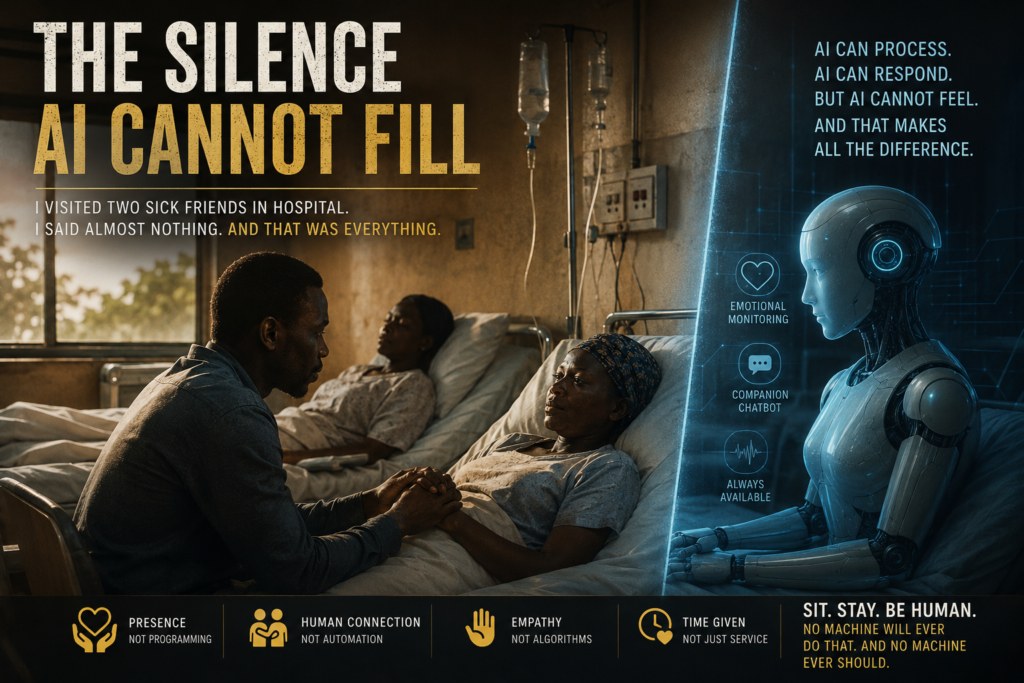
My first friend lay near the window, her body visibly smaller than the last time I had seen her, as though the illness was methodically undoing her, piece by piece.
Meanwhile, a few beds away, my second friend stared at the ceiling with a stillness that carried enormous weight.
She wasn’t sleeping.
Instead, she was somewhere deep inside herself, navigating something no doctor could prescribe for.
So, I pulled a chair close.
I did not offer rehearsed encouragement.
I did not reach for a Bible verse or a motivational quote.
Rather, I simply sat.
I held one hand.
I met the other’s eyes.
I stayed.
What I offered that afternoon was not advice.
Not information.
Not even spoken prayer.
Instead, it was presence.
The raw, unpolished, deeply human act of refusing to leave someone alone in their pain.
Even now, long after I left that hospital, I carry that afternoon with me, turning it over in my mind like a stone with something written underneath.
Then I Heard About the Robots
Not long after, I began noticing something in conversations around healthcare and technology.
AI-powered tools.
Care robots.
Emotional monitoring systems.
Companion chatbots.
The demonstrations were impressive.
The intentions were good.
And yet, something in me resisted.
Something that had been sitting in that ward in Jinja refused to be convinced.
Because, in the end, I kept returning to one simple truth:
Those tools, however advanced, would never have been able to do what I did in that room.
Not merely because of a temporary technical limitation.
But rather, because of something far more fundamental.
Empathy is not a function.
It is not an output.
It cannot be coded.
What Empathy Actually Is
To begin with, empathy is not just recognizing someone’s emotions.
It is not generating the right response.
Instead, empathy is being moved.
It is the moment something shifts inside you because of another person’s suffering.
It is involuntary.
It is costly.
It is deeply human.
So when my friend wept, something broke open in me.
Not a process.
Not a trained reaction.
But something real.
Her fear became heavy in my chest because I, too, know fear.
I, too, love people I could lose.
I, too, will die one day.
In that sense, my empathy was not something I chose to perform.
It was something I could not escape.
By contrast, when AI produces “compassion,” it is generating language patterns.
It can sound warm.
It can sound caring.
However, behind those words
There is no one.
No fear.
No grief.
No memory.
No sleepless nights.
The machine is not moved.
And ultimately, that difference, though invisible, is everything.
The Meaning Hidden in Staying
Later on, one of my friends told me something I will never forget:
“What I remember most is that you stayed.”
Not what I said.
Just that I stayed.
And that matters, because I could have left.
I had my own life.
My own responsibilities.
My own fatigue.
Yet, I chose to remain.
And that choice, that small sacrifice, gave my presence meaning.
A machine can be programmed to stay.
It can respond at 3 a.m.
It can be endlessly available.
Still, availability is not the same as love.
A machine stays because it must.
A human stays because they choose to.
And therefore, that choice is what transforms presence into something sacred.
The Danger We Are Not Talking About
At this point, we need to be honest about a growing risk.
As AI companions become more sophisticated, we may begin using them to replace what only humans should give.
For example, if AI sits with the patient so family members don’t have to visit
that is not progress.
That is avoidance.
Similarly, if a lonely person confides only in a machine
that is not connection.
That is substitution.
In other words, we are not solving loneliness.
We are making it easier to ignore.
And so, this is not innovation.
It is abandonment, with better branding.
What We Owe Each Other
To be clear, this is not an argument against technology.
AI has an important role in healthcare:
- Better diagnostics
- Reduced human error
- Wider access to medical knowledge
These things matter.
However, we must draw a line.
There are places where technology can assist.
And then, there are places where only a human being will do.
Sitting with the suffering.
Holding a hand.
Saying nothing when nothing is honest.
This work, above all, belongs to us.
It always has.
And it always will.
Because, ultimately, it is built from something no machine can replicate:
The knowledge that we, too, will one day need someone to stay.
Closing Thoughts
I left Jinja Hospital quieter than I arrived.
On the way home, I found myself looking at the sky differently.
Later that evening, I called my mother, not for a reason, but because I needed a human voice.
My friends’ suffering changed me.
And perhaps that is the final difference.
Machines can process suffering.
They can respond to it.
But they cannot carry it home.
And that is where the line remains:
The line between a tool and a companion.
Between a program and a person.
Between artificial intelligence and human empathy.
So, in the end:
Sit with people.
Stay when it is hard.
Be changed by what you witness.
No machine will ever do that.
And no machine ever should.
What must never be replaced?
About the Author
Realistiqthinker is an independent writer exploring the intersection of philosophy, human dignity, and emerging technology.
With a background in philosophical and ethical studies, theological ethics, and international development, his perspective is shaped by field experience in Pakistan and East Africa.
He is a Certified Monitoring and Evaluation Professional and has completed advanced studies in Artificial Intelligence.
His work examines how technology is reshaping identity, autonomy, and what it means to be human, always with one central question: