

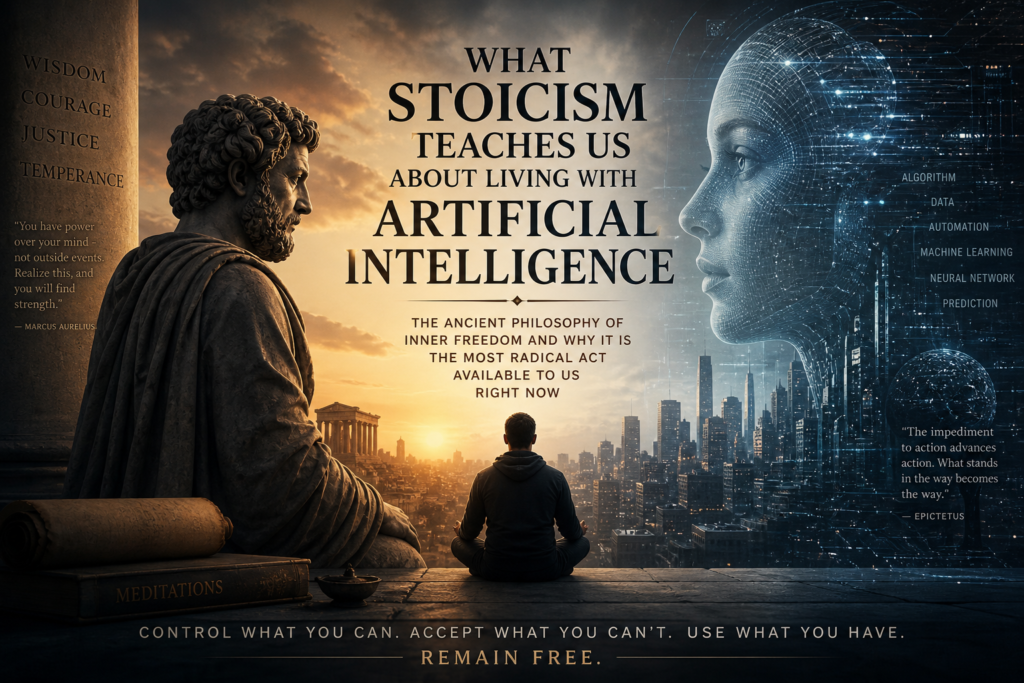
THE ANCIENT PHILOSOPHY OF INNER FREEDOM AND WHY IT IS THE MOST RADICAL ACT AVAILABLE TO US RIGHT NOW
By: Realistiqthinker
Marcus Aurelius governed the Roman Empire at its most complex and violent peak. He commanded armies, managed political betrayal, buried children, and navigated plague and yet the document he left behind is not a manual of conquest. It is a private journal of a man trying, daily, to distinguish what he could control from what he could not, and to act with integrity inside, that distinction. He never published Meditations. He wrote it for himself, which is precisely why it has endured for two thousand years. I think about that discipline constantly. Because we are living through a moment that requires exactly the kind of clarity Marcus was practicing: the ability to look at a force reshaping the world and ask, calmly, without panic and without false comfort what part of this is mine to act on? What part is not? And what does wisdom look like in the space between?
Artificial intelligence is now that force. It is arriving into communities, institutions, and intimate lives at a speed that outpaces comprehension. Most public conversations about it collapse into one of two postures, uncritical enthusiasm or catastrophic fear. The Stoics, I want to argue, offer something better than either. They offer a framework for remaining human inside a transformation you did not entirely choose, and for exercising real agency in the only domain where agency was ever truly available: the interior one.
But I want to make this argument from the ground, not from a philosophy classroom. Because the communities I have spent time with, in places the tech industry has largely not visited with honest attention, have been practicing something recognisably Stoic long before the word became a podcast topic.
The dichotomy of control and who already lives it
The foundational Stoic teaching belongs to Epictetus, a man who knew something about powerlessness. He was born a slave. He lived inside a system of total external constraint and responded by developing the most rigorous internal philosophy of freedom in Western history. His core principle, stated without decoration, is this: some things are in our power and some are not. Our opinions, our impulses, our desires, these are ours. Everything else reputation, wealth, the behaviour of other people, the decisions of systems is not. To confuse the two is the source of all suffering.
Now consider what AI does to this distinction. It arrives, increasingly, as the thing that is not in our power, the hiring algorithm that scores your application before a human reads it, the credit model that assigns your risk before you speak, the content feed that shapes your perception of the world before you have decided what to think about. These are external forces. The Stoic response is not to rage against them or to pretend they are not real. It is to ask, with precision: what remains mine? What can I still choose? And how do I strengthen that inner citadel so that no external system, however sophisticated can colonise it?
Among the Pokot in Turkana, in Kenya’s stark, beautiful northwest, I observed something that struck me as deeply Stoic, even though no one there had read Epictetus. These communities live inside conditions of genuine external scarcity: erratic rainfall, contested land, limited institutional support, and increasing encroachment from both government digitalisation programmes and climate-driven resource pressure. And yet the social fabric held a quality I can only describe as deliberate interiority. Decisions were made through councils that prized careful speech over quick reaction. Elders distinguished, with remarkable consistency, between what the community could act on and what it had to absorb and endure. That is not passivity. That is Stoic discipline, practiced collectively, without the philosophical vocabulary.
“You have power over your mind, not outside events. Realise this, and you will find strength.”-Marcus Aurelius, Meditations
Amor fati the love of what is, not the surrender to it
There is a concept in Stoic philosophy, borrowed and sharpened by Nietzsche, though its roots are Stoic called amor fati: the love of fate. It does not mean passive acceptance. It means something far more active and demanding. It means choosing, consciously, to affirm the reality you find yourself in rather than spending your life resisting it, and from that affirmation, finding the leverage to act on what you can genuinely change.
This distinction matters enormously in the AI conversation. There are people who spend their energy insisting that artificial intelligence should not exist, that its development should be halted, reversed, undone. I understand the impulse. I have seen what poorly designed systems do to Karamojong families in northeastern Uganda who are classified by a mobile welfare survey that has no framework for their social economy. I have watched Pachauri and Kachikoli communities in Hyderabad’s southern margins receive algorithmic verdicts built on the prejudices of whoever labelled the training data. The anger is legitimate.
Nevertheless, the Stoic insight is that expending your primary energy resisting what cannot be reversed is a form of self-defeat. AI is not going away. The more generative question, the amor fati question, is: given that this force exists and will continue to develop, what is the most human, most dignified, most effective response available to us? How do we build interior strength, individual and collective, that no algorithm can reach? And how do we act, from that strength, on the things that genuinely remain within our power to change?
Premeditatio malorum imagining the worst so you are never ambushed by it
The Stoics practised a discipline they called premeditatio malorum, the premeditation of adversity. Each morning, a Stoic practitioner would contemplate the difficulties the day might bring: loss, failure, conflict, the misbehaviour of others. The purpose was not pessimism. It was preparation. By imagining the hard thing in advance, you removed its power to shock you into reaction. You arrived at difficulty with your judgement intact.
I think this is the single most practical Stoic gift available to communities navigating the AI age, and it is almost entirely absent from mainstream technology conversations, which are dominated by either utopian promise or dystopian panic. Almost nobody is saying, plainly and without drama: here are the specific ways this technology is likely to fail the most vulnerable communities. Here is what a biased credit model does to a smallholder farmer in Kajiado who has no formal credit history, only decades of responsible land stewardship that no dataset was built to see. Here is what a predictive policing algorithm does in regions where the training data was itself generated by discriminatory enforcement. Here is what a content recommendation engine does to a young person in Acholi subregion who is still processing collective intergenerational trauma and has just been handed a smartphone.
To name these things in advance, specifically, honestly, without euphemism, is a Stoic act. It is the premeditation of adversity. And it is the precondition for designing systems that do not replicate harm, because you have thought clearly about harm before the product ships, rather than after the damage accumulates.
The Stoic Standard for Technology
Epictetus asked of every situation: is this in my power? The Stoic standard for any AI system should be equally direct, does this technology expand or diminish the inner freedom of the people it touches? Does it strengthen their capacity to reason, choose, and act? Or does it quietly colonise that capacity, replacing their judgement with a score, their agency with a recommendation, their dignity with a data point? A system that passes the first test serves humanity. One that fails it serves only itself.
The inner citadel is not a metaphor it is a practice
Marcus Aurelius used a phrase, the inner citadel, to describe the part of a person that no external force could breach without consent. It was not a romantic notion. He was writing from a position of enormous external power, and he was reminding himself, daily, that the only power worth having was the power over his own responses. The citadel was not built once. It was maintained through practice through daily reflection, through honest self-examination, through the refusal to let circumstance dictate character.
This is the alternative that Stoicism offers a world saturated with artificial intelligence. Not rejection. Not naïve enthusiasm. A practice. The daily, unglamorous, countercultural decision to remain the author of your own attention. To choose what you consume and why. To examine the values embedded in the tools you use rather than accepting them uncritically. To ask, before you defer to an algorithm’s recommendation, is this judgement mine? And if it is not, do I consent to it?
In the Maasai communities I have spent time with in Trans Mara, there is an elder’s practice, one I observed but was never fully taught, of sitting in the early morning before the day’s demands arrive, in a specific, unhurried silence. It is not meditation in the Western wellness sense. It is, as best I could understand it, an act of orientation, a deliberate placement of the self within a larger order before the noise of the world takes over. I do not know what name the Maasai would give it. But I recognise it. Marcus Aurelius did the same thing, in Latin, in a tent at the edge of the Danube, two thousand years ago.
Both of them understood something that our age is in urgent danger of forgetting. The greatest threat posed by any powerful external force, whether empire, plague, or algorithm, is not what it does to your circumstances. It is what it does to your inner life, if you let it. The Stoic answer is to not let it. To build the citadel. To tend it every day. And to act, from that protected centre, with the clarity, the courage, and the unapologetic humanity that no system, however intelligent, was ever designed to replace.
The machine can predict your behaviour. It cannot make your choices. That distinction, quiet, stubborn, and still entirely yours, is where freedom lives.
About the Author
Realistiqthinker
Realistiqthinker is an independent thinker and writer with a background in philosophical and ethical studies, theological ethics, and international development. He holds a Certified Monitoring and Evaluation Professional qualification and has completed studies in Artificial Intelligence. His fieldwork experience spans community development contexts in Pakistan and East Africa. He writes at the intersection of philosophy, human dignity, social justice and emerging technology asking the questions that our increasingly automated world urgently needs to face.