

WHAT A PRUSSIAN PHILOSOPHER KNEW ABOUT DIGNITY THAT SILICON VALLEY HAS YET TO LEARN
By: Realistiqthinker
There is a moment I return to often. I am sitting beneath an acacia tree at the edge of the Trans Mara in Kenya, not far from the Tanzanian border, with a Maasai elder whose name I will not use here because he never asked to be written about. We are talking through translation and through the kind of patient silence that replaces translation when language runs out, about what happens when outsiders arrive with forms. Survey forms, needs-assessment forms, registration forms for government programmes. He pauses for a long time. Then he says, through my interpreter, something I have carried with me ever since. He says: “They come to count us. They do not come to know us.” I did not have the words for it then. But Immanuel Kant did. He had them in 1785.
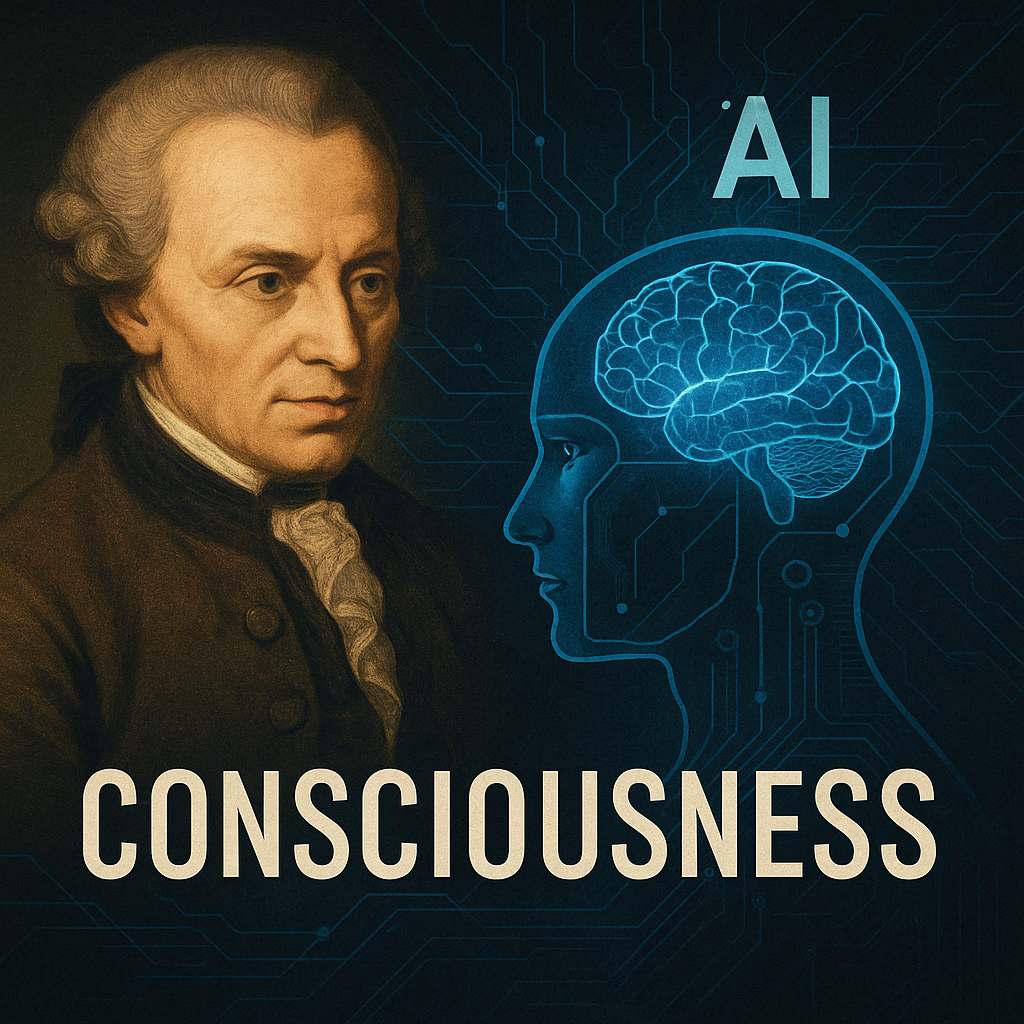
Kant’s Categorical Imperative, his foundational principle of moral philosophy, makes a demand so simple and so devastating that the AI industry has not yet found a way around it. He stated it this way: “Act only according to that maxim by which you can at the same time will that it should become a universal law”. And then, even more pointedly: “Act so that you treat humanity, whether in your own person or in that of another, always as an end and never as a means only.” That second formulation is the one that matters most right now. Because what I have witnessed from the Trans Mara to Turkana, from northeastern Uganda to the outskirts of Hyderabad, is a global technological infrastructure that is systematically treating human beings as means. And it is calling this progress.
The imperative that algorithms violate by design
Kant’s principle is not sentimental. It is structural. He is not asking us to be kind to people. He is arguing that the fundamental condition of moral action is the recognition of the other person as an end in themselves; as a being with intrinsic worth, irreducible to any function they serve or any data point they produce. To treat a person merely as a means is not simply impolite. For Kant, it is a violation of the moral law itself.
Now consider what an algorithmic classification system actually does. It takes a human being with a history, a community, a set of relationships, a particular dignity and converts them into a set of measurable variables. It extracts what is quantifiable and discards what is not. It produces a score, a category, a risk profile. Then it acts on that profile as though the profile were the person. The person has become a means to the system’s end, whether that end is efficient resource allocation, predictive policing, credit scoring, or welfare targeting. The Kantian violation is not incidental to this process. It is the process.
Furthermore, the scale at which this happens multiplies the moral weight enormously. Kant’s imperative asks us to universalise our maxims to ask whether we could, will our way of acting to become a universal law. If we cannot, we must not act that way. So, ask the question plainly: could we will it to become a universal law that every human being is governed primarily through algorithmic profiles, with their full personhood treated as operationally irrelevant? Every honest answer I have ever heard to that question has been no. And yet that is precisely the direction we are moving.
“Act so that you treat humanity, whether in your own person or in that of another, always as an end and never as a means only.”- Immanuel Kant, Groundwork of the Metaphysics of Morals, 1785
What the Karamojong and the Pokot taught me about dignity
I have spent time with Karamojong communities in northeastern Uganda, a people whose entire social and economic architecture is organised around cattle, kinship, and a relationship to land that no database schema has ever adequately captured. I have sat in Pokot communities in Turkana, in Kenya’s arid northwest, where the word for wealth and the word for cattle is, in practice, the same word. And in the Acholi subregion of northern Uganda, a region that endured more than twenty years of Lord’s Resistance Army violence, forced displacement, and the systematic destruction of social trust, I have worked with communities rebuilding themselves from a depth of collective trauma that no needs-assessment tool was designed to measure.
In each of these places, I observed the same pattern. Development organisations and government programmes arrived with digital tools, mobile data collection platforms, beneficiary registration systems, AI-assisted targeting models, and proceeded to extract from these communities precisely what the tools were designed to capture: age, gender, household size, GPS coordinates, income category. What the tools could not capture, and therefore did not, was the Karamojong elder’s role as a living institution of conflict resolution, the Pokot woman’s knowledge of seasonal water sources that sustained her entire sub-county, the Acholi communities carefully rebuilt social contract after two decades of war. These things were not in the data. Therefore, for the system, they did not exist.
Kant would have identified this instantly. The tool was not treating these people as ends. It was treating them as means, as data sources for a model serving an agenda, they did not author and a system they did not govern. The extraction was efficient. The representation was a lie. And the policy decisions downstream from that representation carried the authority of evidence, while the people those decisions shaped had no meaningful recourse.
Hyderabad and the weight of a label
In southern Pakistan, specifically in and around Hyderabad, I worked alongside Pachauri and Kachikoli communities, minority groups and tribal peoples who carry the compressed dismissal of a single word: tribal. It is a word that functions as a verdict. It places a person inside a category before they have spoken a word, and it shapes every institutional encounter that follows, from welfare eligibility to security assessment, from educational opportunity to the probability of being flagged by a predictive algorithm as a person of interest.
This is the Kantian violation made visible. The label is a means of processing people at scale. It is efficient. It saves time. It allows institutions to act without the costly, slow, uncomfortable process of actual encounter. Nevertheless, it destroys the very thing Kant argued was the foundation of moral life, the recognition of the other as a being whose worth is not conferred by the category they fall into but is intrinsic to their existence as a person.
When an AI system inherits a label like tribal from its training data, when it learns that certain communities are associated with certain risk levels, certain development deficits, certain behavioral patterns, it does not challenge the label. It scales it. It gives the prejudice a confidence interval and calls it insight. That is not objectivity. That is Kant’s worst case, a moral violation so systematised that it no longer feels like one.
The Moral Test That AI Cannot Pass
Kant’s universalizability test is simple: would you be willing for every person on earth to be governed by the same rule you are applying to this person? If the answer is no, if those building these systems would not accept algorithmic profiles as the primary basis for decisions about their own healthcare, their own creditworthiness, their own freedom, then the moral logic demands they not impose it on others. Especially not on communities with the least power to refuse.
The alternative Kant actually offers
I want to be precise about what I am proposing, because this essay is not a rejection of technology. It is an argument for a different foundation. Kant does not ask us to feel more warmly toward people we govern. He asks us to restructure the act of governance itself, so that the person being governed retains their status as an end, as a full moral agent, rather than being reduced to the material through which someone else’s objective is achieved.
Applied to AI, this means something very specific. It means designing systems in which the communities most affected by algorithmic decisions have genuine authority over how those decisions are made, not consultation, not feedback forms, but structural power. It means treating the knowledge held by a Maasai elder in Kajiado or a Kachikoli community leader in Hyderabad not as background colour for a report but as a form of expertise that the system must be accountable to. It means building AI tools that expand human agency rather than replacing human judgement, tools that give a community worker more capacity to see, rather than tools that tell them what to conclude before they have looked.
That is a harder, slower, more expensive path. It does not lend itself to the language of disruption or the metrics of scale. However, it is the only path that satisfies the moral demand Kant placed at the centre of ethical life, the demand that every person, in every community, regardless of how inconvenient their complexity is to the system, be treated as an end. Not as a data point. Not as a beneficiary category. Not as a risk score. As a person, with irreducible worth, whose dignity is not negotiable.
The elder under the acacia tree in Trans Mara already knew this. He did not need Kant to tell him. He needed the people arriving with their forms to already believe it before they got off the plane. That, more than any technical specification or ethical framework, is the change our moment most urgently requires.
To count a person is not to know them. And to know them, truly, morally, with the full weight of what knowing costs, is the only foundation on which any system claiming to serve human dignity can honestly stand.
About the Author
Realistiqthinker
Realistiqthinker is an independent thinker and writer with a background in philosophical and ethical studies, theological ethics, and international development. He holds a Certified Monitoring and Evaluation Professional qualification and has completed studies in Artificial Intelligence. His fieldwork experience spans community development contexts in Pakistan and East Africa. He writes at the intersection of philosophy, human dignity, social justice and emerging technology, asking the questions that our increasingly automated world urgently needs to face.
Если вы хотите [url=https://www.dizaynerskiye-barnyye-stulya.ru/]дизайнерские барные стулья купить в москве[/url], наш магазин предлагает широкий выбор стильных и качественных моделей.
Важно учитывать стиль интерьера и личные предпочтения при покупке барного стула.
Спасибо за ваш комментарий! Мы полностью согласны с тем, что при выборе барных стульев важно учитывать стиль интерьера и личные предпочтения. Комфорт, качество и дизайн играют ключевую роль в создании идеального пространства.
На нашей платформе мы стремимся помогать пользователям принимать взвешенные решения, предлагая полезные советы, сравнения и идеи в области мебели и дизайна интерьера.
Ознакомьтесь с другими нашими материалами, чтобы найти вдохновение и создать пространство, которое действительно отражает вашу индивидуальность и потребности.
Спасибо, но сейчас это не актуально для меня.