

WHEN PHILOSOPHY BECOMES A PERMIT AND THE REST OF US PAY THE PRICE
By: Realistiqthinker
I want to begin not in a library but in a place, Nietzsche never visited and would likely never have thought to. The Acholi subregion of northern Uganda. A community in the long shadow of more than twenty years of Lord’s Resistance Army violence, where children were abducted, villages burned, and an entire generation grew up inside displacement camps, cut off from land, from elders, from the slow accumulated wisdom of their own culture. When I interact with my close friends there, what struck me most is not the scale of the suffering. It was the resilience that nobody was interested in scaling. The rebuilt social structures. The community courts. The ceremonies of return. The extraordinary, unhurried, deeply collective process of becoming whole again. None of that was investable. None of it disrupted anything. And so, none of it appeared in the development reports that donors actually read.
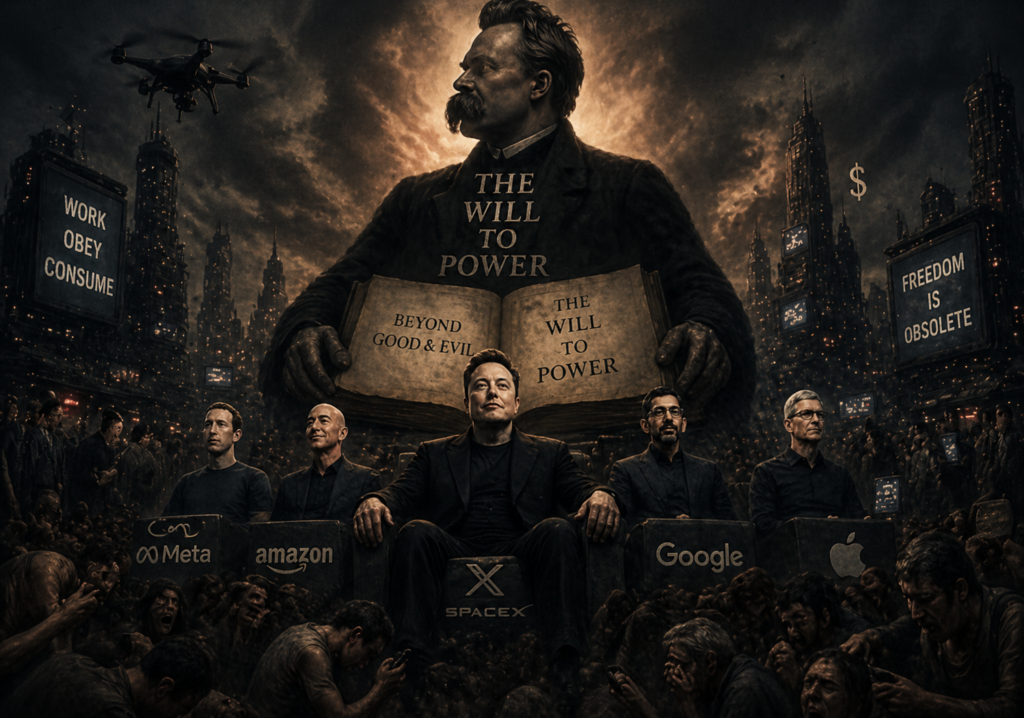
I thought about those communities recently when I read yet another profile of a Silicon Valley billionaire describing their work in terms unmistakably drawn from Friedrich Nietzsche, the language of the exceptional individual, the visionary who breaks old values to build new ones, the person whose will is large enough to reshape the world. The Übermensch. The one who operates beyond the moral frameworks that constrain ordinary human beings. I want to think carefully about this, about what Nietzsche actually said, about what the tech elite have done with it, and about what it looks like from the places where the consequences land.
What Nietzsche actually meant, and what was done with it
Nietzsche’s concept of the Wille zur Macht, the will to power, is one of the most misread ideas in the history of philosophy. He did not mean the domination of other people. He meant the drive toward self-overcoming the internal force that pushes a human being to master themselves, to create meaning in a world that offers none, to become more fully what they are. For Nietzsche, the highest expression of power was artistic, philosophical, creative. It was the sculptor who imposes form on raw material. The philosopher who dismantles dead values to make room for living ones.
Furthermore, Nietzsche was a relentless critic of exactly the kind of power most commonly associated with his name. He despised the herd mentality of mass movements. He was contemptuous of the nationalist politics his sister later tried to attach to his legacy. He would have recognised, I think, the irony of billionaires quoting him while running companies whose entire business model depends on the conformity, addiction, and predictability of hundreds of millions of ordinary people. That is not self-overcoming. That is the herd, monetised.
Nevertheless, the misreading has consequences. When powerful people organise their self-image around the idea that they are the exceptional few, the ones with a vision large enough to exempt them from the moral considerations that bind everyone else, the effects reach far beyond their own psychology. They shape policy. They shape technology. They shape which communities get to matter.
“The higher we soar, the smaller we appear to those who cannot fly.”- Friedrich Nietzsche, Thus Spoke Zarathustra
The Maasai, the Pokot, and the view from above
There is a particular kind of arrogance that comes with altitude and I mean that both literally and metaphorically. I have spent time among Maasai communities in the Trans Mara and in Kajiado, not far from the Tanzanian border. I have sat with Pokot communities in Turkana, in Kenya’s vast, arid northwest. These are peoples with sophisticated relationships to land, to water, to seasons, to cattle relationships built across generations and carrying a kind of practical intelligence that no satellite image has ever fully captured.
And yet, when tech-funded development initiatives arrive in these regions, mapping platforms, digital land registries, mobile financial infrastructure, satellite-based agricultural advisory tools, they arrive with the posture of revelation. We have seen what you cannot see. We have the data. We have the platform. We are here to help you become legible to the world that matters. The will to power, in this reading, expresses itself as the will to make others readable, to translate complex, living communities into data architectures that serve someone else’s agenda. What is left out of that translation is not incidental. It is often the most important thing.
Among the Karamojong in northeastern Uganda, I observed a land-use digitisation programme that mapped grazing territory with confident precision. The maps were beautiful. They were shared at donor conferences. However, they captured the territory as it existed in a particular season, at a particular moment, through a satellite lens that had no way of encoding the decades of inter-clan negotiation embedded in those patterns. The tech organisation behind the project had the will. They had the power. What they did not have and did not seem to notice they lacked, was the wisdom that comes from staying long enough to be changed by what you find.
Hyderabad and the Übermensch who never arrives
In southern Pakistan, specifically in and around Hyderabad, I worked alongside Pachauri and Kachikoli communities, minority and tribal peoples who have lived for generations inside the defining gaze of those with more institutional power. The word tribal, as I have written before, functions as a verdict. It places a person in a category before the conversation has begun. What I want to add here is the specific way that tech-inflected development programmes inherit and amplify this dynamic.
When a fintech platform launches in a region like Hyderabad’s peri-urban and rural margins, it arrives with the narrative of inclusion, bringing the unbanked into the financial system, giving the marginalised access to the formal economy. This narrative is not entirely false. Access does matter. However, the platform is not designed by or for Pachauri and Kachikoli communities. It is designed by people who have diagnosed the problem from the outside and built a solution that requires the community to conform to the platform’s logic rather than the other way around. The will to power, here, manifests as the will to define the problem, and therefore to own the solution, the data, the profit, and the story.
Nietzsche’s Übermensch was supposed to be the one who creates new values rather than imposing old ones. What we have instead, in much of the tech industry’s engagement with marginalised communities globally, is the opposite, the imposition of a particular value system, rooted in Silicon Valley’s cultural assumptions, onto communities that had functioning value systems of their own. That is not self-overcoming. That is the oldest story in the world, wearing a new interface.
The Question Nietzsche Would Actually Ask
Nietzsche’s real challenge to power was always internal. He asked: have you overcome yourself? Have you examined your own values honestly enough to know whether they are genuinely yours, or whether they are inherited, comfortable, self-serving? The tech billionaire who has never sat with a Karamojong elder, never walked a Pokot woman’s seasonal water route, never listened without an agenda to a community rebuilding after twenty years of war, that person has not overcome themselves. They have simply accumulated leverage and called it vision.
The alternative that Nietzsche himself points toward
I want to be honest about something. Nietzsche is not wrong that the world needs people with the courage to challenge dead values and build new ones. He is not wrong that mediocrity and conformity are dangers. The Acholi communities I worked with in northern Uganda had, in the aftermath of war, done something genuinely Nietzschean, they had refused the identity of permanent victimhood, rebuilt their own governance structures, and insisted on telling their own story on their own terms. That is self-overcoming. That is the will to power expressed as it was meant to be, as creation, not domination.
The alternative, therefore, is not to abandon Nietzsche’s challenge. It is to reclaim it from the people currently misusing it. True self-overcoming, in the context of technology and power, would look like this: a tech leader who submits their assumptions to genuine scrutiny by the communities most affected by their platforms. An investor who accepts that the return on a project might be measured in community agency rather than user growth. A developer who treats the knowledge of a Maasai elder in Kajiado or a Kachikoli community leader in Hyderabad not as local colour but as a form of expertise that must shape the design.
That requires a different kind of will, not the will to impose, but the will to be changed. Not the will to rise above the ordinary, but the will to descend into it fully enough to understand what it actually contains. Nietzsche called the capacity to endure difficult truths about oneself the mark of a genuinely strong person. By that standard, the most powerful people in the technology industry have, so far, shown very little power at all.
The will to reshape the world means nothing if you have never allowed the world the real one, the inconvenient one, the one that does not fit your model to reshape you first.
About the Author
Realistiqthinker
Realistiqthinker is an independent thinker and writer with a background in philosophical and ethical studies, theological ethics, and international development. He holds a Certified Monitoring and Evaluation Professional qualification and has completed studies in Artificial Intelligence. His fieldwork experience spans community development contexts in Pakistan and East Africa. He writes at the intersection of philosophy, human dignity, social justice and emerging technology asking the questions that our increasingly automated world urgently needs to face.