


By Realistiqthinker…
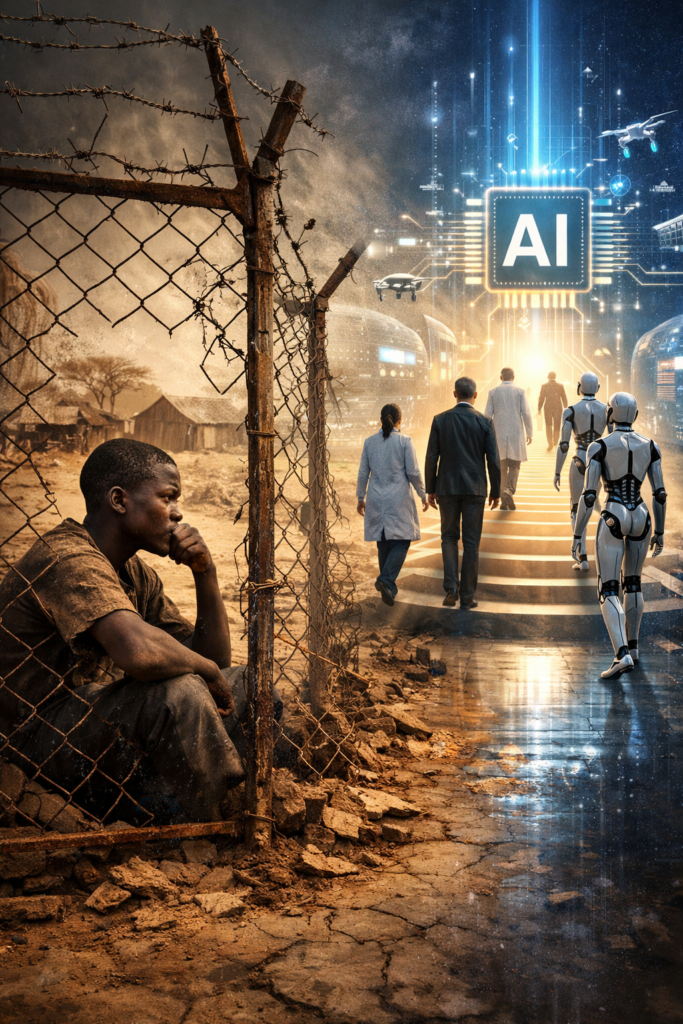
I have sat inside a Maasai manyatta in Kenya. Not as a tourist. Not as a researcher with a clipboard and a research protocol approved by a university ethics committee thousands of miles away. But as someone who was simply there, living alongside people whose relationship with time, land, community and knowledge operates according to a logic so different from the world that is supposedly being built for them that the distance feels not just geographical but civilizational.
I have also lived among the Karamojong in Uganda, a pastoral people whose entire way of life is organized around cattle, seasons, ancestral memory and a sophisticated understanding of their environment that no algorithm has ever been asked to learn from or respect.
I think about those communities often. I think about them when I read the breathless announcements coming out of Silicon Valley, London and Beijing about artificial intelligence transforming the world. I think about them when technology leaders speak about AI as the great equalizer, the tool that will finally bring opportunity to the people history has left behind.
And I feel something between frustration and fury. Because the Africa I lived in is not the Africa that the artificial intelligence revolution is being built for. And the gap between those two realities is not a technical problem waiting for a technical solution. It is a political, economic and moral failure hiding behind the language of innovation.
The numbers tell a story nobody wants to hear
Let me be specific because specificity matters when powerful institutions prefer vagueness.
Africa represents approximately 17 percent of the global population. It represents less than one percent of global AI research output. Of the billions of dollars invested in AI development globally in recent years, the African continent receives a fraction so small it barely registers in the data.
According to research tracking global AI investment patterns; the entire African continent receives less AI investment annually than a single mid-sized American technology company raises in one funding round. The continent that contains 54 countries, over 1.4 billion people and more linguistic and cultural diversity than any other region on earth, is treated as an afterthought in the most consequential technological development of our lifetime.
This is not a natural outcome as markets do not simply forget 1.4 billion people by accident. In my opinion, this is a choice, made repeatedly, quietly and with enormous consequences for the human beings on the receiving end of it.
What I Learned from the Maasai that Silicon Valley cannot buy
The Maasai have survived and navigated one of the most demanding environments on earth for centuries. Their knowledge of weather patterns, animal behavior, medicinal plants, seasonal migration routes and community conflict resolution represents an accumulated intelligence refined across generations of rigorous real-world testing. Actually, this is not romantic mythology. This is sophisticated knowledge that works, that has sustained complex human communities through drought, disease, colonial disruption and the relentless pressure of modernization.
Now ask yourself a simple question. How much of that knowledge is in the training data of any major AI system currently being deployed in East Africa?
The answer is effectively none. The large language models and AI systems being rolled out across the continent were trained overwhelmingly on English language text, Western academic literature, digitized books from European and American libraries and internet content that systematically overrepresents wealthy, educated, connected populations.
The Maasai elder who can read the sky and predict a drought three weeks before it arrives, knowledge that could save lives and livestock across an entire region, does not exist in the data. The Karamojong understanding of cattle health, pasture management and community resource allocation developed over centuries of pastoral living, gone. Invisible. Uncounted.
We are building an artificial intelligence that is genuinely ignorant of the majority of human wisdom ever developed on this earth. And we are calling it intelligence.
The Infrastructure Lie
When technology advocates are challenged about Africa’s exclusion from the AI revolution the first response is almost always infrastructure.
The argument is, Africa does not have reliable electricity and does not have sufficient internet connectivity. Also, that Africa does not have the computational resources. And therefore, Once the infrastructure improves the benefits of AI will naturally follow.
This argument sounds reasonable. It is also deeply dishonest. Firstly, Infrastructure does not build itself. It is built by investment, by political will and by decisions made in boardrooms and government offices about whose development matters and whose does not. The infrastructure deficit in Africa is not a geographical accident, it is the cumulative result of decades of underinvestment, exploitative debt structures, colonial era resource extraction and the continued outflow of capital from the continent that keeps local economies perpetually underfunded.
Moreover, the infrastructure argument conveniently ignores what is already happening.
AI systems are already being deployed across Africa, in healthcare, in financial services, in agriculture, in law enforcement, often without adequate local input, without cultural adaptation and without accountability structures that protect the communities being subjected to them. The infrastructure is apparently sufficient when there is profit to be extracted. It becomes insufficient when the question is local ownership, local development or local benefit.
Thus this selective infrastructure concern deserves to be named for what it is.
The Karamojong and the Algorithm
When I lived among the Karamojong, I witnessed a community navigating genuine complexity, managing scarce resources, resolving conflicts between clans, making collective decisions about land use and movement in response to environmental conditions that changed constantly.
Their decision-making processes were not primitive. They were sophisticated, participatory and remarkably effective at managing competing interests within a framework of shared values and long-term thinking.
Now those communities are increasingly subject to digital systems, aid distribution algorithms, biometric registration databases, mobile financial platforms, designed by people who have never sat with a Karamojong elder, never witnessed a community negotiation, never understood the social architecture that makes those communities function.
The result is predictable and tragic.
Systems that cannot recognize the complexity of pastoral land use misclassify communities as landless and therefore ineligible for certain protections. Biometric systems that struggle with darker skin tones, a documented and persistent problem in facial recognition technology, create registration failures that exclude the most vulnerable from services they are entitled to. Financial algorithms trained on formal economy behaviors cannot accommodate the seasonal, communal and nonlinear financial lives of pastoral communities.
The technology arrives with confidence. It leaves behind confusion, exclusion and a quiet erosion of the community structures that actually kept people safe.
The brain drain that never gets mentioned
Here is something that makes this situation actively worse and that almost nobody is talking about.
Africa produces talented, brilliant mathematicians, computer scientists, engineers and researchers. Countries such as Ghana, Nigeria, Kenya, South Africa, Rwanda, are generating technical talent that is genuinely world class. Unfortunately, the global technology industry is systematically recruiting that talent outward.
The African AI researcher who might have built systems responsive to African realities, trained on African languages, designed for African contexts is instead optimizing recommendation algorithms for American social media platforms or building financial models for European investment banks.
This is not simply a brain drain. It is a targeted extraction of the one resource that could actually change Africa’s relationship with artificial intelligence, local human expertise with both technical capability and genuine cultural knowledge.
The continent loses twice. Once when the investment does not come. Again, when the people who could generate it locally are recruited away.
This is not inevitable
I want to resist the narrative of African victimhood because it is both inaccurate and counterproductive.
There are extraordinary things happening across the continent. For instance, Rwanda is building genuine AI policy infrastructure. Also, Kenya’s technology ecosystem is producing innovations that are solving African problems in ways that Western solutions never could. Take a look at Nigeria’s fintech revolution has demonstrated that African contexts can produce technology that leapfrogs Western models rather than simply copying them. Furthermore, South Africa has research institutions producing serious AI work. Ethiopia is investing in local language AI development for Amharic and other Ethiopian languages that global systems have completely ignored.
These examples matter. They prove that the exclusion of Africa from the AI revolution is not inevitable, it is a policy choice that can be reversed by different policy choices.
But reversal requires honesty about what is actually happening. It requires naming the extractive logic clearly. It requires pressure on international institutions, technology corporations and African governments simultaneously.
And it requires voices from the Global South, people who have actually lived in these communities, who understand the texture of these realities from the inside, to refuse to be silent while decisions are made about their world by people who have never visited it.
A final word to the People building this future
If you are developing AI systems that will be deployed in Africa, go there first. Not for a conference. Not for a research visit with a fixed itinerary and a return ticket booked before you arrive.
Sit with the Maasai. Live among the Karamojong. Spend time in communities whose intelligence, whose knowledge and whose humanity your systems are currently incapable of seeing. Then come back and build something different.
This is because the artificial intelligence that excludes the majority of human wisdom, that extracts value from the most vulnerable, that replicates colonial logic in digital form, that is not intelligence.
It is just the same old power wearing a new disguise.
About the AuthorRealistiqthinker is an independent thinker and writer with a background in philosophical and ethical studies, theological ethics, and international development. He holds a Certified Monitoring and Evaluation Professional qualification and has completed studies in Artificial Intelligence. His fieldwork experience spans community development contexts in Pakistan and East Africa — including time living among the Maasai in Kenya and the Karamojong in Uganda and Tanzania. He writes at the intersection of philosophy, human dignity, social justice and emerging technology — asking the questions that our increasingly automated world urgently needs to face