
There are moments when language feels less like a tool and more like a mystery. You say something simple, and yet it carries more than words. It carries tone, memory, silence, intention. It carries you.
And then there are moments when language feels empty. Precise, structured, correct and yet strangely hollow.
That tension is where this reflection begins.
A Brief Glimpse of Ludwig Wittgenstein
He lived a life that resisted comfort. Born into wealth, Ludwig Wittgenstein gave much of it away. He worked as a schoolteacher, a soldier, even a gardener. He moved between silence and speech as if both mattered equally.
What made him unforgettable was not only what he wrote, but how he questioned. He believed that many philosophical problems were not problems at all, but confusions about language.
To understand meaning, he insisted, we must look not at words themselves, but at how they are used in life.
That insight feels almost prophetic today.
When Language Leaves the Human World
I have spent time in places where language is inseparable from life.
Among pastoral communities in East Africa, words are not abstract. They carry relationships. A greeting is not a formality; it is recognition. A story is not entertainment; it is memory preserved.
In northern Uganda, in the Acholi subregion shaped by years of conflict, I listened to conversations where silence mattered as much as speech. Meaning lived between words as much as within them.
And in marginalized communities in southern Pakistan, I encountered language shaped by struggle, identity, and resilience. Words were not just spoken. They were lived.
However, when I began working more closely with digital systems, I noticed something different.
Language was being processed, not experienced.
The Rise of Machine Language
Machines now generate, interpret, and respond to language at a scale that feels almost unreal.
They translate, summarize, recommend, and predict. Furthermore, they do so with increasing accuracy.
At first, this seems like progress. Communication becomes faster. Information becomes accessible. Barriers appear to dissolve.
And yet, something subtle begins to shift.
Language starts to lose its grounding in life.
Meaning Without Experience
Wittgenstein would likely ask a simple but unsettling question:
Can there be meaning without lived experience?
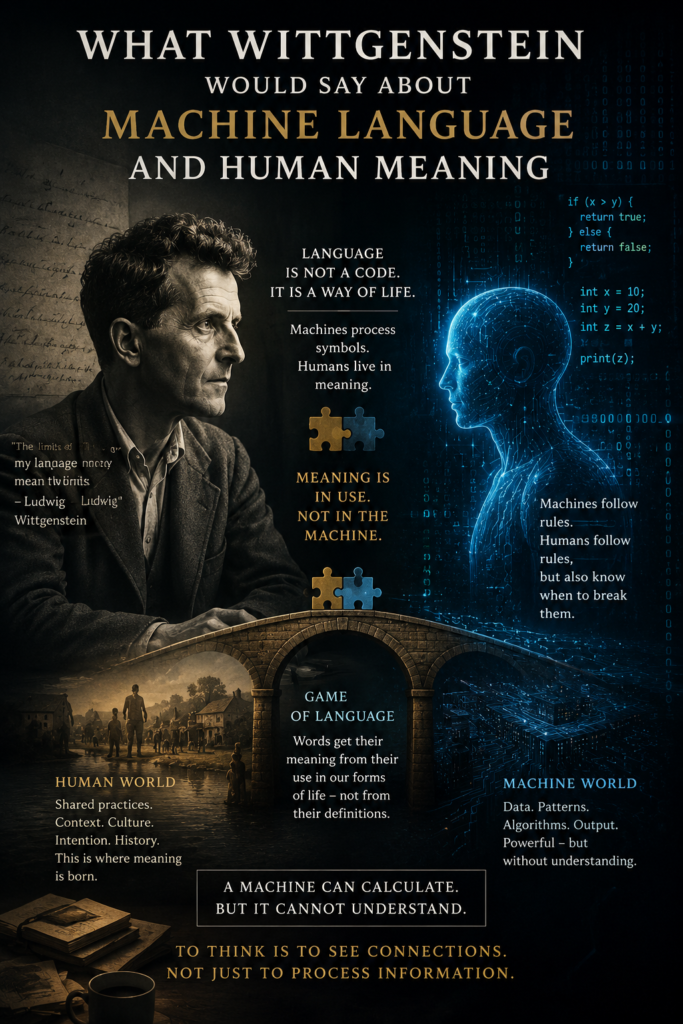
Machines process patterns. They recognize structures. They predict what comes next based on what has come before.
However, they do not live the contexts that give language its depth.
They do not hesitate before speaking. They do not carry memory in the human sense. They do not feel the weight of words spoken in grief, in love, or in uncertainty.
And yet, they produce language that appears meaningful.
This creates a tension we are only beginning to understand.
The Illusion of Understanding
One of the most striking aspects of machine language is how convincing it can be.
It answers questions. It explains concepts. It even reflects emotions.
Nevertheless, this does not necessarily mean it understands.
Wittgenstein argued that meaning comes from use, from participation in what he called “forms of life.” Language is not a code to be decoded. It is an activity to be lived.
Machines participate in patterns, not in life.
Therefore, their “understanding” is fundamentally different.
And yet, because their responses resemble human language, we are tempted to treat them as equivalent.
When We Begin to Adapt to Machines
What concerns me is not only how machines use language, but how we begin to change in response.
I have noticed people simplifying their speech to be better understood by systems. Shorter sentences. Clearer structures. Reduced ambiguity.
At first, this seems practical. However, over time, it shapes how we think.
We begin to prioritize clarity over depth. Efficiency over expression.
And slowly, language starts to align more with machines than with human experience.
The Loss of the Unsaid
In every place I have worked, some of the most important communication happens without words.
A pause. A gesture. A shared silence.
These moments carry meaning that cannot be easily translated into language, let alone into data.
However, machine systems depend on what can be captured, measured, and processed.
Therefore, they privilege what is said over what is felt.
This creates a subtle distortion.
The unsaid begins to disappear.
Language as a Living Practice
Wittgenstein would remind us that language is not static. It evolves with use. It reflects culture, context, and community.
This is why the same word can mean different things in different places.
It is also why meaning cannot be fully standardized.
Machines, however, require standardization. They depend on patterns that can be generalized.
And yet, human language resists that.
It thrives on nuance, contradiction, and ambiguity.
A New Kind of Misunderstanding
We often think of misunderstanding as a failure of communication.
However, in a world shaped by machine language, misunderstanding may take a different form.
We may believe we understand each other because the words are clear.
And yet, the depth behind those words may be missing.
This is not confusion.
It is something quieter.
A kind of surface-level clarity that hides deeper gaps in meaning.
What This Means for Human Connection
If language becomes increasingly shaped by machines, then human connection will inevitably be affected.
Conversations may become more efficient, but less meaningful.
Expression may become more precise, but less personal.
And yet, people do not connect through precision alone.
They connect through shared experience, vulnerability, and the unpredictable nature of human interaction.
These cannot be fully replicated by systems.
An Alternative Way Forward
The goal is not to reject machine language. It offers real benefits. It expands access. It supports communication. It opens new possibilities.
However, we must remain aware of its limits.
First, we must preserve spaces where language remains human, messy, imperfect, and deeply contextual.
Second, we must resist the urge to reduce all communication to efficiency. Not everything valuable can be optimized.
Furthermore, we must continue to engage with language as a lived practice. Conversations should not only exchange information; they should build understanding.
And finally, we must remember that meaning is not produced by words alone. It emerges from life itself.
The Question That Remains
After years of moving between different worlds, some deeply rooted in lived experience, others increasingly shaped by digital systems, I find myself returning to a simple question:
Are we still speaking to each other, or are we beginning to speak through systems?
The difference may seem small.
And yet, it carries profound implications.
Final Reflection
Wittgenstein once suggested that the limits of our language are the limits of our world.
Today, our language is expanding in ways he could not have imagined. Machines generate it, process it, and distribute it at unprecedented scale.
And yet, expansion does not always mean deepening.
If language becomes detached from life, it risks becoming empty, even when it appears full.
Therefore, the challenge is not to compete with machines in producing language.
It is to remain grounded in the experiences that give language its meaning.
Because in the end, words do not matter on their own.
They matter because of the lives that speak them.
Realistiqthinker
About the Author
Realistiqthinker is an independent thinker and writer with a background in philosophical and ethical studies, theological ethics, and international development. He holds a Certified Monitoring and Evaluation Professional qualification and has completed studies in Artificial Intelligence. His fieldwork experience spans community development contexts in Pakistan and East Africa. He writes at the intersection of philosophy, human dignity, social justice and emerging technology, asking the questions that our increasingly automated world urgently needs to face.