
By: Realistiqthinker
A night of certainty that shaped centuries: René Descartes
He was a soldier, a mathematician, and a restless thinker who distrusted everything that could not survive doubt. In 1619, alone in a heated room in the Netherlands, René Descartes experienced a series of dreams that convinced him he had discovered a method capable of grounding all human knowledge.
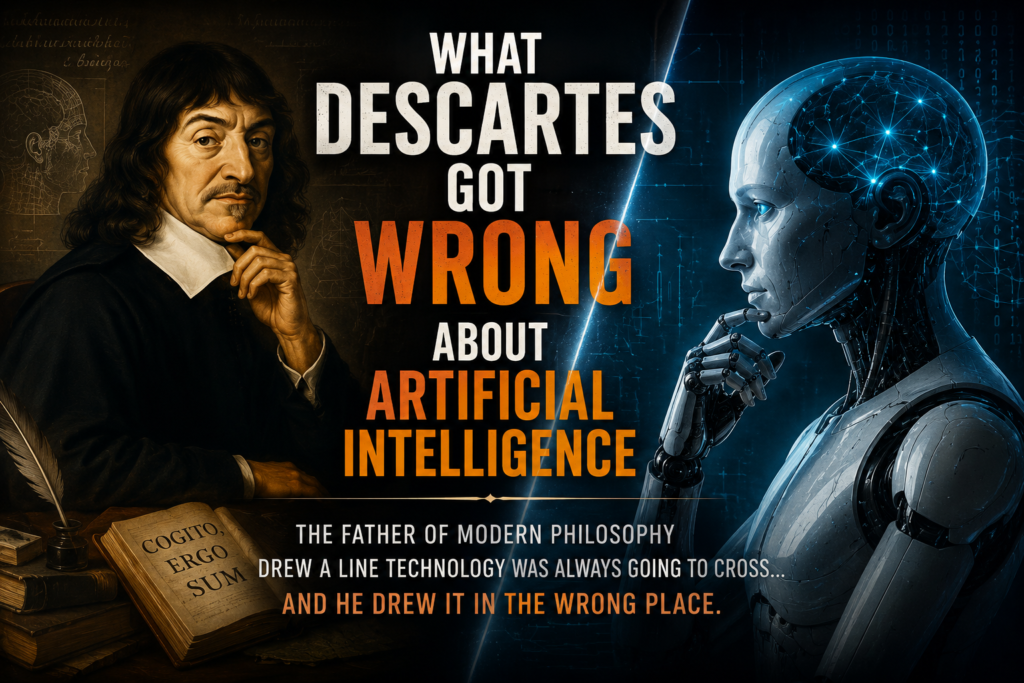
From that moment, he pursued certainty with relentless discipline. He stripped away assumptions, questioned perception, and arrived at a conclusion so simple it became immortal: Cogito, ergo sum- I think, therefore I am.
Nevertheless, in drawing that conclusion, Descartes also drew a boundary. He separated the thinking mind from the physical body, reason from experience, subject from world. It was elegant. It was powerful.
And yet, it was wrong in a way we are only now beginning to understand.
The question the machine cannot answer
Years ago, in Turkana in northern Kenya, I sat with a Pokot elder as he examined a mobile health diagnostic tool introduced into his community. The system could identify symptoms, suggest treatments, and flag critical cases. It was efficient. It was precise.
He watched it quietly, then asked a question that has never left me: does the machine know what it means to be sick?
However, within a Cartesian framework, the answer would seem straightforward. If sickness can be defined through measurable symptoms, then a system that processes those symptoms effectively “knows” sickness.
And yet, that answer feels incomplete.
Because something essential is missing.
The Cartesian split and its silent consequences
Descartes divided reality into two domains: res cogitans, the thinking substance, and res extensa, the extended, physical world. The mind became the site of truth. The body became a mechanism.
Furthermore, knowledge was defined as something abstract, universal, and detachable from lived experience. Sensation became unreliable. Emotion became suspect. The body became secondary.
This division did not remain in philosophy. It shaped science, institutions, and eventually technology.
Therefore, when artificial intelligence models intelligence as computation, it is not inventing something new. It is inheriting a centuries-old assumption that thinking is separable from being.
Why the algorithm feels like home
Modern AI systems treat intelligence as information processing. Data enters. Patterns emerge. Predictions follow.
This structure mirrors Descartes’ vision almost perfectly. The mind becomes a system. Knowledge becomes calculation. Understanding becomes output.
Nevertheless, what fits neatly into this framework is only part of human intelligence.
The rest embodied knowledge, relational awareness, emotional attunement remains outside the model. Not because it lacks value, but because it resists reduction.
What the body knows
Among the Karamojong in northeastern Uganda, I once observed a herder reading the land in a way no satellite system could replicate. He noticed subtle shifts in vegetation, soil tone, and animal behavior. He predicted rainfall patterns with quiet confidence.
However, his knowledge was not abstract. It was embodied. It lived in movement, in memory, in years of physical presence within that environment.
Similarly, among Pachauri communities in southern Pakistan, I witnessed forms of social intelligence that no algorithm could interpret. Community mediators sensed tension before it surfaced. They adjusted conversations through tone, silence, and timing.
Furthermore, these decisions were not calculated. They were felt.
Descartes had no space for this kind of knowing. His framework required knowledge to be detached, universal, and transferable.
And yet, the most reliable knowledge in these contexts was none of those things.
The cost of ignoring what cannot be computed
When AI systems adopt a purely Cartesian model of intelligence, they exclude forms of knowledge that matter most in real human contexts.
A healthcare algorithm may identify symptoms accurately. However, it cannot understand suffering as lived experience. A financial model may predict risk efficiently. Yet it cannot grasp resilience built outside formal systems.
Therefore, decisions made through these systems often fail precisely where they claim to succeed.
They optimize outcomes while misunderstanding realities.
The ghost we are trying to rebuild
The philosopher Gilbert Ryle once criticized Descartes by calling his theory the “ghost in the machine.” He argued that separating mind from body created an illusion, an invisible entity controlling a mechanical system.
And yet, today, we are attempting something even stranger.
We are building machines and trying to insert the ghost back into them.
The pursuit of artificial general intelligence assumes that consciousness, understanding, and meaning can emerge from sufficient computational complexity.
However, this assumption rests entirely on the Cartesian belief that mind is fundamentally computational.
If that belief is flawed, the entire project stands on uncertain ground.
The Acholi insight beyond cognition
In northern Uganda, among Acholi communities recovering from decades of conflict, I witnessed something that challenges the Cartesian model at its core.
Healing did not occur through analysis alone. It required ritual, presence, and collective memory. It required bodies gathering, voices rising, and shared silence holding grief that words could not contain.
Furthermore, understanding emerged not from detached reasoning but from lived participation.
No algorithm can replicate that. Not because it lacks power, but because it lacks embodiment.
And embodiment is not an accessory to intelligence. It is part of its foundation.
What Descartes got right and why it matters
It would be easy to dismiss Descartes entirely. However, that would be another mistake.
His commitment to doubt, to questioning assumptions, remains one of the most powerful intellectual tools we possess.
Furthermore, his insistence on clarity and method has shaped every scientific advancement that followed.
Therefore, the problem is not that Descartes valued reason. The problem is that he defined it too narrowly.
He reduced intelligence to what could be abstracted, leaving out what could only be lived.
Toward a wider understanding of intelligence
If artificial intelligence is to serve human beings meaningfully, it must move beyond the Cartesian model.
This does not mean abandoning computation. It means expanding the definition of knowledge itself.
First, systems must recognize their limits. Not everything can be measured. Not everything should be reduced.
Second, they must remain accountable to human experience. Data cannot replace presence. Models cannot replace relationships.
Furthermore, communities must not be treated as sources of data alone. They must be recognized as holders of knowledge that systems cannot generate independently.
Therefore, the goal is not to make machines more human. It is to ensure that human intelligence in all its forms remains central.
The line we must redraw
Descartes drew a line between mind and body, believing that clarity required separation.
However, the future demands a different kind of clarity, one that recognizes connection rather than division.
Intelligence is not only what we think. It is how we inhabit the world. It is how we relate, perceive, and respond.
And yet, if we continue to design systems that ignore this, we risk building technologies that function perfectly and understand nothing.
Closing reflection
The Pokot elder’s question remains unanswered, not because it is unanswerable, but because it exposes a deeper truth.
A machine can identify illness. It can predict outcomes. It can recommend treatment.
But it does not know what it means to be sick.
And unless we recognize that difference, we will continue to mistake calculation for understanding.
Descartes gave us a method that built the modern world.
Now we must decide whether we are wise enough to see where it led us and bold enough to go beyond it.
About the Author
Realistiqthinker
Realistiqthinker is an independent thinker and writer working at the intersection of philosophy, human dignity, and emerging technology. With a background in philosophical and ethical studies, theological ethics, and international development, he brings a field-based perspective shaped by work in Pakistan and East Africa.
He holds a Certified Monitoring and Evaluation Professional qualification and has completed studies in Artificial Intelligence. His work challenges dominant assumptions about intelligence, knowledge, and progress in an increasingly automated world.