

A philosopher who saw movement inside reality: Georg Wilhelm Friedrich Hegel
He was born in Stuttgart in 1770, into a world that still believed history unfolded under fixed truths. Yet Hegel sensed something different. He saw motion where others saw stability. He saw contradiction where others saw order.
While Ludwig van Beethoven gave sound to human struggle, Hegel gave it structure. He believed reality itself was not static but unfolding history as a process in which ideas clash, fracture, and reorganize into something new.
He watched Napoleon Bonaparte ride through Jena and called him “the world-spirit on horseback,” not out of admiration alone, but because he recognized history moving in real time.
Nevertheless, Hegel’s deepest claim was not about individuals. It was about process. He argued that history advances through tension. A position emerges, meets its contradiction, and through struggle produces something neither side could have predicted.
And yet, he could not have imagined how relevant that insight would become in an age of intelligent machines.
The conflict we are already inside
We often speak about artificial intelligence as if it is arriving. However, it has already arrived. It shapes decisions, filters reality, and increasingly mediates how human beings encounter the world.
Therefore, the real question is not whether machines will transform human life. The transformation is underway. The question is how that transformation will resolve.
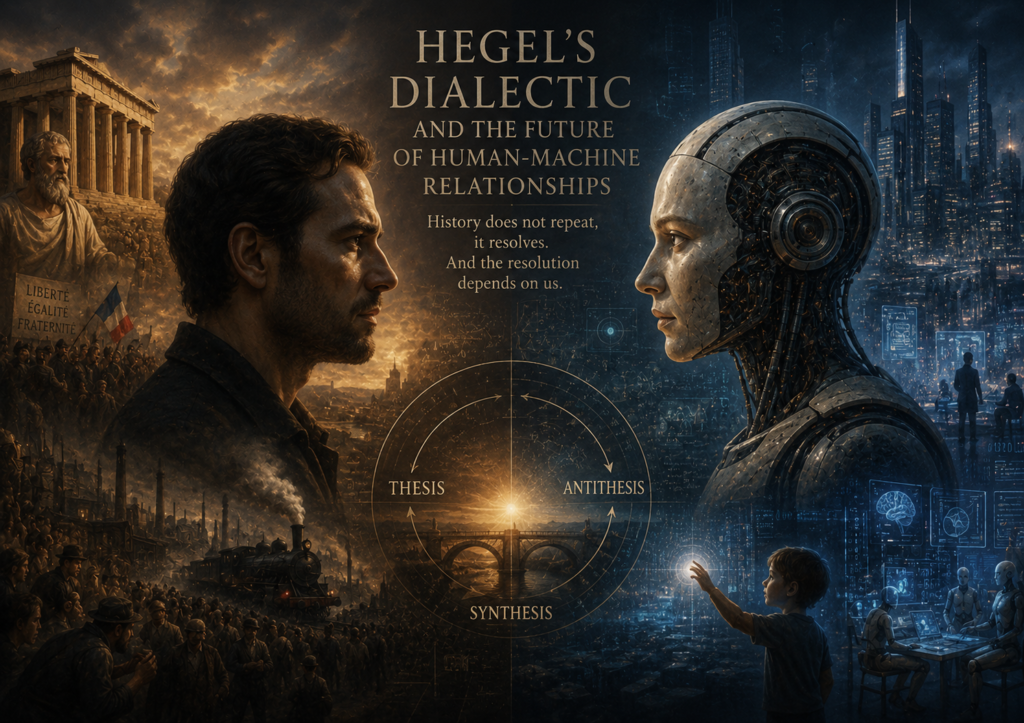
Hegel offers a framework that cuts through the noise. He would not ask whether humans or machines will win. He would ask what synthesis will emerge from their encounter.
Thesis, the human being as presence
For most of history, the human being stood at the center of every meaningful system. Decisions carried faces. Authority carried voices. Responsibility could be located.
Even in imperfect systems, there remained a possibility of encounter. A decision could be challenged. A story could be told. A judgment could be reconsidered.
I have seen this across contexts among the Karamojong in northeastern Uganda, among the Pokot across the Turkana corridor, and among marginalized communities in southern Pakistan. Systems often failed them. However, those systems still contained human entry points.
Nevertheless, the defining feature of the human-centered world was not fairness. It was presence. Someone was there.
That presence made transformation possible.
Antithesis, the machine that replaces encounter
The machine does not arrive as an extension of this world. It arrives as its contradiction.
Where the human system depended on presence, the machine depends on abstraction. Where human judgment moved through conversation, the algorithm moves through calculation.
Furthermore, the machine does not negotiate. It processes. It does not listen. It predicts. It does not reconsider. It updates.
In Hyderabad, working with Kachikoli communities, I witnessed this shift with clarity. A digital welfare system replaced a human process. It was faster. It was cleaner. It was consistent.
And yet, something disappeared.
The conversation vanished. The appeal vanished. The possibility of being seen beyond the category vanished.
Therefore, efficiency increased, but humanity thinned.
The illusion of improvement
It is tempting to call this progress. After all, systems that reach more people with fewer resources appear superior.
However, Hegel would urge caution. Not every replacement is an advancement. Some are negations disguised as solutions.
The machine does not simply improve the human system. It removes what it cannot process. It discards ambiguity. It eliminates contradiction.
And yet, human life is made precisely of those elements.
Therefore, when systems eliminate them, they do not refine reality. They reduce it.
The dialectical moment we cannot avoid
Hegel believed that conflict is not a problem to eliminate but a condition to engage. A genuine synthesis emerges only when both sides fully confront each other.
This is where the present moment becomes decisive.
The human being represents depth, context, moral ambiguity, and relational understanding. The machine represents speed, scale, pattern recognition, and consistency.
Furthermore, neither is sufficient alone.
A purely human system struggles with scale and bias. A purely machine-driven system struggles with meaning and justice.
Therefore, the task is not to choose. It is to integrate.
Where synthesis is already visible
Synthesis is not theoretical. It is already emerging, though often in places the world overlooks.
In Trans Mara and Kajiado, among Maasai communities, I observed how technology was introduced without surrendering local knowledge. Satellite data informed land decisions. However, elders interpreted that data through lived experience.
The system did not replace tradition. It strengthened it.
Similarly, in northern Uganda among Acholi communities, digital tools were used to document oral histories and customary land systems. However, the authority remained with the people.
The machine served memory. It did not define it.
And yet, what made these examples powerful was not the technology itself. It was the structure of relationship.
The human remained the Subject. The machine became the instrument.
The failure we risk repeating
However, not all trajectories lead toward synthesis. Many systems move toward domination by the antithesis.
When algorithms replace judgment entirely, when efficiency becomes the highest value, when human input is reduced to data points, the dialectic collapses.
Hegel warned that unresolved contradictions do not disappear. They accumulate. They intensify.
Therefore, systems that suppress the human dimension may appear stable. Yet they carry within them a future rupture.
The communities most affected will not remain silent indefinitely.
And when the tension resurfaces, it will not ask politely for adjustment. It will demand transformation.
A test for every system we build
Hegel’s philosophy offers a practical test, not just a theoretical insight.
A system moving toward genuine synthesis must preserve what is essential in both the human and the machine.
It must retain human accountability, moral reasoning, and relational depth. Furthermore, it must incorporate the machine’s ability to process scale, detect patterns, and enhance reach.
If one side disappears, the synthesis is false.
If the system becomes efficient but unaccountable, it has failed.
If it remains human but ineffective at scale, it has also failed.
Therefore, the measure is not balance. It is integration at a higher level.
The ethical responsibility of this moment
Hegel believed that history is not something that happens to us. It is something we participate in.
And yet, participation requires awareness.
Many of the systems shaping the future are being designed without philosophical reflection. Engineers optimize performance. Institutions pursue efficiency. Markets reward scale.
However, none of these forces ask the deeper question: what kind of human–machine relationship are we creating?
Therefore, the responsibility falls beyond technical expertise. It requires ethical imagination. It requires philosophical courage.
It requires asking not only what works, but what is worth building.
Beyond fear and surrender
There are two common reactions to artificial intelligence. One is fear-the belief that machines will replace human beings entirely. The other is surrender-the belief that technological progress is inevitable and must be accepted without resistance.
Both responses misunderstand the dialectic.
Hegel would reject both.
The future is not predetermined. It is negotiated.
And yet, negotiation requires presence. It requires that human beings remain active participants rather than passive recipients.
The resolution is still open
We are not at the end of this process. We are in the middle of it.
The synthesis between human and machine has not yet fully formed. It is being shaped, in design rooms, in policy decisions, in communities adapting to systems they did not create.
Therefore, the resolution is not guaranteed.
It depends on whether we allow one side to dominate or insist on a genuine encounter between both.
It depends on whether we reduce human beings to data or insist that data serves human beings.
It depends, ultimately, on whether we understand what is at stake.
Closing reflection
Hegel believed that history moves toward greater self-awareness.
However, that movement is not automatic. It requires recognition. It requires effort. It requires the willingness to face contradiction without escaping into simplicity.
Today, the contradiction stands clearly before us.
Human beings and machines are no longer separate domains. They are intersecting realities.
And yet, what emerges from that intersection is not decided by technology alone.
It is decided by us.
About the Author
Realistiqthinker
Realistiqthinker is an independent thinker and writer working at the intersection of philosophy, human dignity, and emerging technology. With a background in philosophical and ethical studies, theological ethics, and international development, he brings a field-based perspective shaped by work in Pakistan and East Africa.
He holds a Certified Monitoring and Evaluation Professional qualification and has completed studies professional training course in Artificial Intelligence. His work focuses on ensuring that technological progress does not come at the cost of human meaning, dignity, and agency.