

I first encountered the idea of class not in a book, but in a landscape.
In Trans Mara, among Maasai pastoralists, I watched wealth move on four legs. Cattle were not just assets; they were identity, security, and power. Ownership meant survival. Loss meant vulnerability. No one needed theory to explain inequality. It was visible in herds, in land, in who spoke and who remained silent.
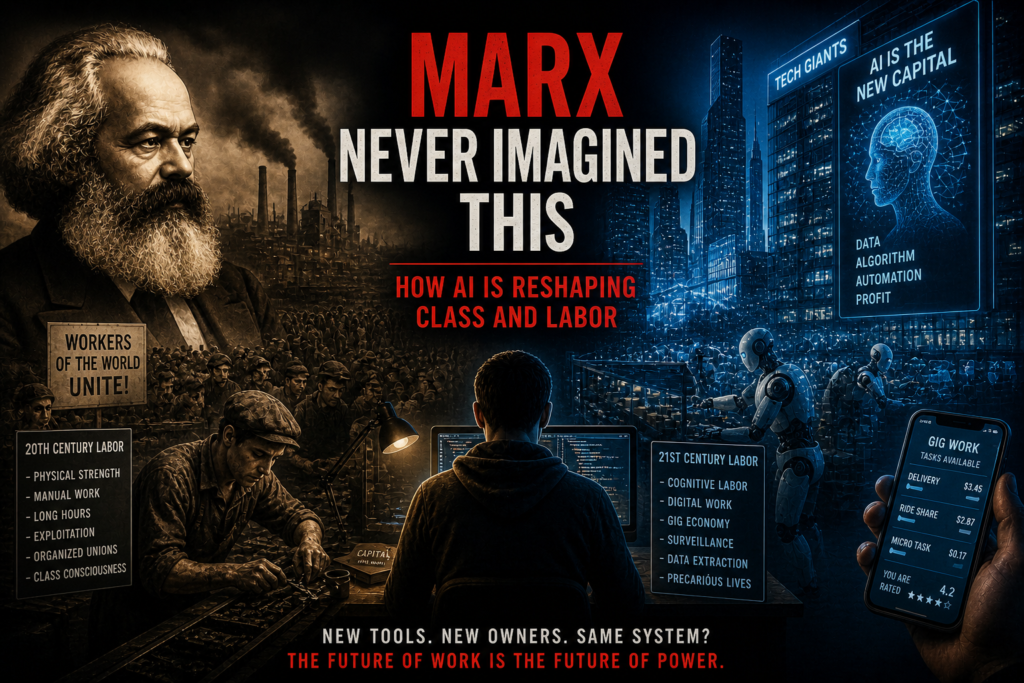
Years later, when I finally studied Karl Marx, his language felt strangely familiar. He spoke of class, labor, and ownership with a clarity that echoed what I had already seen. However, what I am witnessing now, across continents and contexts is something Marx never imagined.
Class has not disappeared. It has evolved.
And artificial intelligence is accelerating that transformation in ways we are only beginning to understand.
Marx in His Time: A Brief Grounding
Marx wrote during the Industrial Revolution, when machines began to reshape production and redefine labor. His central argument was direct: society divides into those who own the means of production and those who sell their labor.
Factories replaced fields. Workers sold time and effort in exchange for wages. Meanwhile, owners accumulated profit by controlling production. Therefore, class struggle became inevitable.
What made Marx powerful was not just his critique, but his clarity. He identified exploitation where others saw progress. He saw that systems could produce inequality even without explicit malice.
And yet, his framework assumed something fundamental: labor remained human.
That assumption no longer holds.
When Labor Is No Longer Human
I realized this shift gradually, not suddenly.
In northeastern Uganda, among the Karamojong, labor was physical, immediate, and deeply tied to survival. Herding, negotiating, protecting these were not abstract tasks. They required presence.
In northern Uganda’s Acholi subregion, rebuilding after decades of conflict depended on human labor in its fullest sense: emotional, relational, and communal. No machine could mediate reconciliation.
However, in more structured environments, especially in development and administrative systems, I began to see labor changing.
Tasks that once required judgment were being automated. Decisions that once required conversation were being processed.
At first, it seemed efficient. Nevertheless, something deeper was shifting.
Labor itself was becoming optional.
The Rise of the Invisible Worker
Marx focused on the worker in the factory. Visible. Countable. Essential.
Today, many workers have become invisible.
Algorithms perform tasks once done by humans. Data systems replace clerks. Automated processes replace intermediaries. Furthermore, decisions happen without direct human involvement.
And yet, behind every system, there are still people.
Data annotators. Content moderators. Gig workers training models.
However, unlike industrial workers, they are dispersed, often unrecognized, and rarely protected. Their labor does not produce physical goods. It produces intelligence, machine intelligence.
This is where the shift becomes profound.
The new “means of production” is not land or machinery alone. It is data. It is computation. It is algorithmic control.
And ownership of these resources defines a new kind of class.
A New Class Structure Emerging
In my work in southern Pakistan, particularly among marginalized communities around Hyderabad, I observed how access defines opportunity.
Those who understand systems navigate them. Those who do not remain excluded.
Now imagine this dynamic at a global scale.
A small number of actors control vast amounts of data and computational power. They design systems that shape markets, influence decisions, and determine visibility.
Meanwhile, the majority interacts with these systems without understanding them.
This creates a new divide.
Not just between labor and capital, but between those who design intelligence and those who are shaped by it.
Therefore, class is no longer only about who owns factories. It is about who owns the architecture of decision-making.
Exploitation Without Awareness
One of Marx’s key insights was that workers could be exploited without fully realizing it.
That insight feels even more relevant today.
In Turkana, among the Pokot communities, labor is direct. Effort leads to outcome. The connection is clear.
However, in digital systems, the connection is often hidden.
People generate data simply by living, through communication, movement, consumption. That data fuels algorithms. Those algorithms generate value.
And yet, most people receive no direct benefit from this process.
This is not exploitation in the traditional sense. It is subtler.
It operates without confrontation. Without visibility.
Nevertheless, it redistributes value in ways that reinforce inequality.
The Illusion of Merit
Modern systems often promote the idea of meritocracy. Success appears to depend on skill, effort, and adaptability.
However, my field experience has taught me that context matters more than we admit.
In marginalized communities, talent exists in abundance. Opportunity does not.
Algorithms, however, tend to reward what is already visible. They amplify patterns found in existing data. Therefore, they often reinforce existing hierarchies rather than disrupt them.
This creates an illusion.
It appears that systems are fair because they are data-driven.
And yet, the data itself reflects historical inequalities.
Marx spoke of how systems reproduce class structures. Today, algorithms perform a similar function, but with greater speed and scale.
The Shift from Labor to Relevance
Perhaps the most significant change I have observed is this:
Class is no longer defined only by labor, but by relevance.
In pastoral communities, everyone has a role. Labor may differ, but contribution is visible.
In algorithmic systems, however, some people become irrelevant.
If a system does not recognize you, it does not include you. If it does not include you, you effectively disappear from decision-making processes.
This is not unemployment in the traditional sense. It is exclusion at a structural level.
And it is deeply destabilizing.
Why Marx Still Matters and Where He Falls Short
Marx helps us see structure. He helps us recognize that inequality is not accidental.
However, his framework does not fully capture the world we are entering.
He did not anticipate a system where labor could be replaced not by machines alone, but by intelligence.
He did not imagine a world where value could be extracted from behavior itself, without formal employment.
And yet, his core question remains relevant:
Who controls the system, and who benefits from it?
That question has not changed.
Only the system has.
An Alternative Way Forward
If we accept that AI is reshaping class and labor, then the question becomes urgent: what do we do about it?
First, we must rethink ownership. Data and algorithms should not remain concentrated in the hands of a few. More inclusive models must be explored.
Second, we must redefine value. Human dignity cannot depend solely on economic productivity. Contributions that cannot be automated care, community, creativity must be recognized and supported.
Furthermore, education must evolve. Not everyone needs to become a programmer. However, everyone must understand how systems shape their lives. Awareness is a form of power.
And finally, we must protect space for human judgment. Not every decision should be optimized. Some require context, empathy, and moral reasoning.
The Question That Stays with Me
Across all the places I have worked from East Africa to South Asia I have learned that people do not fear change as much as they fear being left behind.
That fear is growing.
Not because technology is advancing, but because its benefits are unevenly distributed.
Marx saw inequality in factories. Today, it exists in systems we cannot see.
And yet, the responsibility remains ours.
Will we allow a new class structure to emerge without question?
Or will we shape it intentionally, with justice at its center?
Final Reflection
I often think back to those early experiences in pastoral communities. Decisions were not always fair, but they were visible. They could be challenged. They could be changed.
Today, decisions are faster, more efficient, and often more distant.
And yet, distance does not remove responsibility.
If anything, it demands more awareness.
Marx never imagined this world.
But he did warn us about systems that concentrate power and obscure responsibility.
That warning still stands.
The difference is that now, the system is no longer just industrial.
It is intelligent.
And unless we engage with it critically, it will shape not only how we work, but who we become.
Realistiqthinker
About the Author
Realistiqthinker is an independent thinker and writer with a background in philosophical and ethical studies, theological ethics, and international development. He holds a Certified Monitoring and Evaluation Professional qualification and has completed studies in Artificial Intelligence. His fieldwork experience spans community development contexts in Pakistan and East Africa. He writes at the intersection of philosophy, human dignity, social justice and emerging technology, asking the questions that our increasingly automated world urgently needs to face.