
I did not first understand the danger of systems in a courtroom, or in a book, or even in a lecture hall. I understood it standing in dust.
In Trans Mara, among Maasai herders, I once watched a man decide which cow to sell so his children could eat that week. The decision carried weight. He hesitated. Others spoke. Silence followed. Then he chose. No one mistook that moment for anything other than what it was: a moral act, shaped by necessity and responsibility.
Years later, sitting behind a screen, I watched decisions of similar weight unfold in milliseconds. No hesitation. No voices. No silence. Just output.
That contrast has never left me.
Where I First Saw Responsibility
My work has taken me across places where life is not abstract. Among the Karamojong in northeastern Uganda, I saw how decisions over grazing land could trigger tension or preserve fragile peace. In Turkana, with the Pokot communities, I learned how deeply people understand consequence because they live with it daily.
And in northern Uganda, in the Acholi subregion still carrying the scars of more than twenty years of war, I sat with people who rebuilt life slowly. Decisions there were never rushed. They were weighed against memory, loss, and hope.
What struck me in all these places was not perfection. People made mistakes. Bias existed. Power dynamics were real. However, responsibility was never hidden. When harm occurred, it had a face. When justice was sought, it had a direction.
That clarity, I now realize, is what we are quietly losing.
When I Began to Notice Something Different
My time in Pakistan brought this shift into sharper focus. Working with marginalized communities, often labeled as “tribal,” such as Pachauri’s and Kachikoli in southern regions around Hyderabad, I began to see how systems shape lives in ways that are not always visible.
Access to services was not always denied openly. Instead, it was filtered. Delayed. Redirected.
At first, I thought this was simply bureaucracy. However, as I encountered more structured decision-making systems, data-driven tools, digital platforms, automated processes and I began to notice something unsettling.
No one seemed fully responsible anymore.
A person could say, “That is what the system shows.” Another would add, “We follow the data.” And just like that, decisions affecting real lives became detached from those making them.
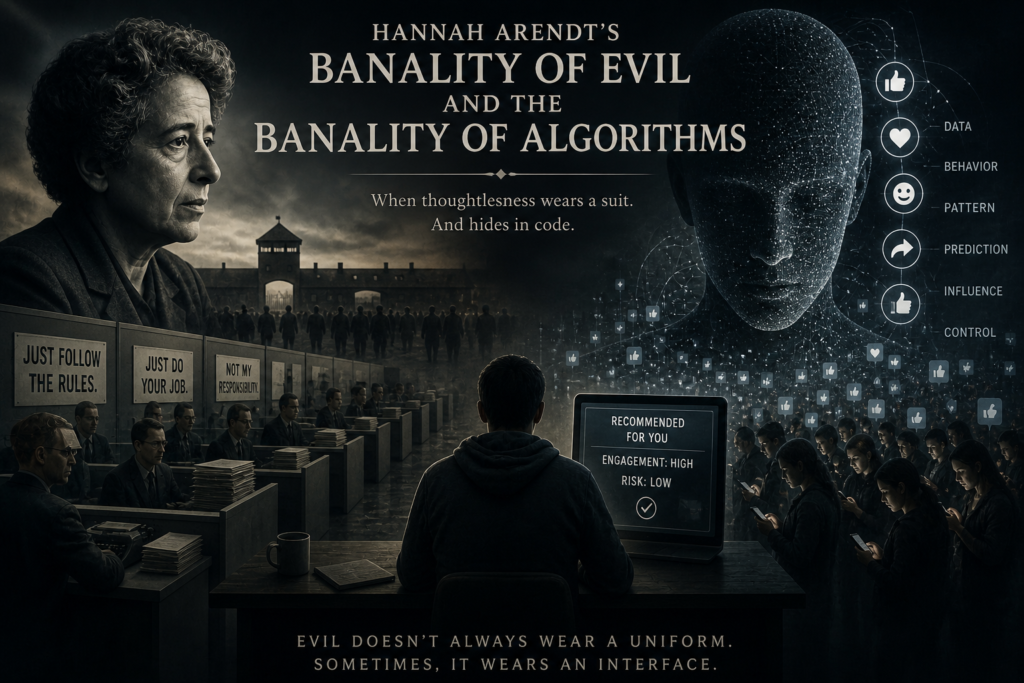
That was the moment I remembered a concept I had once studied: the banality of evil.
The Quiet Familiarity of Harm
The idea is simple, yet deeply uncomfortable. Harm does not always come from hatred. Sometimes, it comes from ordinary people doing their jobs without questioning the systems they serve.
I began to wonder: what happens when those “ordinary people” are replaced, or assisted, by algorithms?
At first glance, algorithms seem harmless. They process information. They identify patterns. They help us make faster decisions. Furthermore, they promise efficiency in a world that constantly demands speed.
And yet, the more I observed their use, the more I noticed something familiar.
The absence of questioning.
The Day I Realized What We Were Losing
I remember reviewing a dataset meant to improve service delivery in a marginalized community. It looked clean. Organized. Efficient. However, something was missing.
People.
Their stories, their struggles, their contradictions, none of it was present. Everything had been reduced to categories, indicators, and probabilities.
At that moment, I thought back to a conversation in Acholi. A woman once told me, “You cannot understand us if you only count us.”
That sentence stayed with me because it revealed something algorithms cannot grasp. Human life is not only data. It is context. It is history. It is dignity.
Nevertheless, algorithms operate by reducing complexity. They must. That is how they function.
And yet, when we rely on them too heavily, we begin to adopt their way of seeing the world.
The Comfort of Not Thinking
One of the most dangerous shifts I have observed is how easily people surrender judgment to systems.
It is not always intentional. In fact, it often feels responsible. After all, who would argue against data? Who would question a system designed to be objective?
However, I have learned that objectivity without reflection can become a shield.
A shield that protects us from asking difficult questions.
I have heard people say, “The algorithm decided.” As if that ends the conversation. As if the decision carries no moral weight because it was produced by a machine.
And yet, every algorithm is built by human hands. It reflects choices, what to include, what to ignore, what to prioritize.
Those choices do not disappear simply because they are encoded.
The Spread of Invisible Decisions
What unsettles me most is not any single algorithm. It is the accumulation of them.
They decide who gets access to opportunities. Who is considered risky. Who is visible. Who is not.
Each decision appears small. Insignificant, even. However, taken together, they shape entire realities.
In communities already living on the margins, these invisible decisions can deepen exclusion. Not through direct denial, but through quiet omission.
And yet, because the process is hidden, it is rarely challenged.
That is how harm becomes ordinary.
Why This Feels Familiar
When I reflect on the environments I have worked in, I realize something important.
The most dangerous systems were never the loudest ones. They were the ones that felt normal.
The ones people stopped questioning.
In that sense, the rise of algorithmic decision-making does not represent a completely new danger. It reflects an old one, taking a new form.
The danger of acting without thinking.
The danger of following processes without examining their consequences.
The danger of allowing systems to define what is acceptable.
What We Must Refuse to Lose
Despite all this, I am not against technology. I have seen its potential. I have studied its possibilities. I understand its value.
However, I believe we are at a point where we must make a choice.
Do we allow systems to replace our judgment?
Or do we insist that they remain tools, guided by human values?
For me, the answer comes from the places that shaped my understanding of life.
From the Maasai elder who paused before making a decision.
From the Acholi communities who rebuilt trust through dialogue.
From the marginalized groups in Pakistan who continue to demand recognition despite systemic barriers.
They all taught me the same lesson:
Human dignity cannot be automated.
An Alternative Way Forward
If we are to avoid repeating old mistakes in new forms, we must rethink how we design and use algorithms.
First, we must remain present in decision-making. Systems can assist, but they should not replace human responsibility.
Second, we must question outputs, not just inputs. Just because a system produces an answer does not mean the answer is just.
Furthermore, we must include diverse voices in the creation of these systems. Without this, they will continue to reflect narrow realities.
And finally, we must slow down when necessary. Not every decision benefit from speed. Some require reflection, dialogue, and moral courage.
The Question I Carry with Me
After years of working across different contexts, I find myself returning to a simple but unsettling question:
Are we still thinking?
Or have we begun to outsource not only our decisions, but also our responsibility to reflect on them?
I do not have a perfect answer.
However, I know this: the danger is not that algorithms will become evil.
The danger is that they will become ordinary.
And in that ordinariness, we may stop noticing the harm they produce.
Final Reflection
I have stood in places where decisions shaped survival. I have seen the weight of responsibility carried openly.
Today, I see decisions made faster, more efficiently, and often more quietly than ever before.
And yet, I cannot help but feel that something essential is slipping away.
Not intelligence.
Not capability.
But the willingness to pause, to question, and to take responsibility.
If we lose that, no system, no matter how advanced, will be able to replace it.
And perhaps that is where the real danger lies.
Realistiqthinker
About the Author
Realistiqthinker is an independent thinker and writer with a background in philosophical and ethical studies, theological ethics, and international development. He holds a Certified Monitoring and Evaluation Professional qualification and has completed studies in Artificial Intelligence. His fieldwork experience spans community development contexts in Pakistan and East Africa. He writes at the intersection of philosophy, human dignity, social justice and emerging technology asking the questions that our increasingly automated world urgently needs to face.