
By Realistiqthinker
Let me tell you about a moment that stayed with me. I was sitting with a man who had just lost everything in his life. Not through laziness or bad choices but through circumstances that had simply crushed him, the kind of suffering that arrives uninvited and refuses to leave. He was not looking for solutions that day. He was not looking for information or advice or a list of available resources. He just needed someone to sit with him in it. For many people will say, he needed someone who will empathize with him.
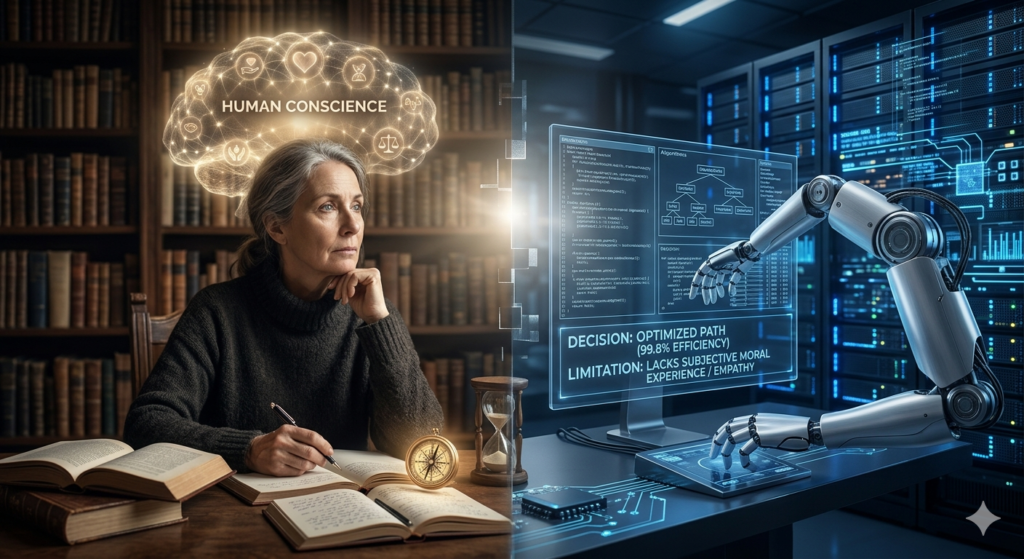
I believe, no machine will ever be able to do what happened in that room. Not because machines are not powerful. They are extraordinarily powerful. But because what that moment required was not intelligence. It required conscience.
And conscience is something that no algorithm, no matter how sophisticated, no matter how much data it has consumed, will ever genuinely possess.
The confusion we keep making
We have made a category error that is becoming increasingly dangerous. We keep confusing intelligence with conscience. We see a machine that can write poetry, diagnose diseases, predict human behavior and pass university examinations, and we begin to wonder whether perhaps it is only a matter of time before it develops genuine moral understanding as well.
In my view, it is an understandable confusion. But it is a profound one. Laughable…right?
What is intelligence? Intelligence is the capacity to process information, recognize patterns and generate responses. And Conscience is something categorically different. In my opinion, it is the capacity to feel the weight of a decision. To be disturbed by injustice not because you calculated that injustice is suboptimal but because something inside you recoils from it. To choose what is right even when every rational calculation points toward what is convenient.
These are not the same thing. They have never been the same thing. And no increase in computing power will close the distance between them.
What Conscience Actually is….

Philosophers have argued about conscience for centuries. However, across different traditions, different cultures, different frameworks, something consistent emerges.
Conscience is not simply knowing the rules. It is being affected by the reality of another person’s experience. It is the capacity for genuine moral discomfort, the feeling that keeps you awake at night when you have done something wrong, or failed to do something right. It is rooted in something that philosophy has always recognized as foundational to ethics, the ability to truly see another human being as fully real, fully valuable and fully deserving of consideration.
This capacity does not come from data. It comes from being alive in a human body, in a human community, shaped by relationships and loss and joy and failure and the slow accumulation of experiences that teach you, not abstractly but viscerally, what it means to suffer and what it means to flourish.
An AI system has consumed more text about human suffering than any person could read in a thousand lifetimes. And yet it has never suffered. It has never loved anyone. It has never made a decision that cost it something real. It processes descriptions of conscience without possessing the thing being described. Personally, this is an enormous difference.
The Dangerous delegation
Here is what worries me most. We are not just building AI systems to help with conscience. We are increasingly using them to replace it.
Judges in some countries now receive algorithmic recommendations about sentencing. Hiring managers defer to automated screening systems rather than trusting their own judgment. Social workers are directed by data driven tools that tell them which families are high risk and which are not. Doctors follow AI diagnostic suggestions even when their own clinical intuition is telling them something different.
In each of these cases a human being is quietly stepping back from the full weight of a moral decision and allowing a machine to carry it instead.
I understand why. Moral responsibility is heavy. Conscience is demanding. It is genuinely easier to say the algorithm recommended this than to say I decided this and I will stand behind it. Nevertheless, this delegation comes at an enormous cost.
When conscience is outsourced, it does not disappear. It gets buried. And the people who suffer from decisions made without genuine moral engagement are real human beings whose lives are shaped by systems that were never capable of caring about them in the first place.
Proximity and Moral Reality
There is something that genuine conscience requires that AI structurally cannot have, and that is
Proximity. When you are physically present with another human being, when you can see their face, hear the tremor in their voice, feel the particular quality of their silence, something happens that no remote processing can replicate. Their reality lands on you. Their suffering becomes morally urgent in a way that a data point never can.
This is why the best moral traditions across human history have always emphasized presence. Sit with the suffering. Go to the places of pain. Do not manage human need from a distance.
Looking at AI, it operates entirely from a distance. Every human being it processes is ultimately an abstraction, a configuration of data points that represents a person without ever actually encountering one.
And moral decisions made from permanent abstraction are not really moral decisions. They are calculations dressed in the language of ethics.
What AI Can do and what it cannot
I want to be fair here because fairness matters. Artificial intelligence can do genuinely remarkable things that support human flourishing. It can identify patterns in medical data that save lives. It can flag inconsistencies in legal proceedings that human reviewers missed. It can help overwhelmed social systems process information more efficiently so that human workers can spend more time on the things that actually require human presence.
Used well, as a tool in the hands of people with genuine conscience, AI can amplify our capacity to do good.
But a tool is only as moral as the hand that holds it and the conscience that guides that hand. A hammer does not build a house. A person builds a house using a hammer.
The moment we forget this distinction, the moment we treat the tool as though it possesses the moral agency of the person, we have made a mistake that will cost us dearly.
The responsibility we cannot escape
Here is the uncomfortable truth that I keep returning to. The rise of artificial intelligence does not reduce our moral responsibility. It increases it.
Because now we must be conscientious not only about our own direct decisions but about the systems we build, the systems we deploy, the systems we trust and the systems we allow to operate without adequate scrutiny. Every algorithm making decisions about human lives is a moral instrument created by human choices. And human choices require human conscience to guide them. We cannot build our way out of this responsibility. We cannot automate our way past it.
The world does not need smarter machines. It needs more awake human beings, people willing to feel the full weight of what it means to make decisions that affect other lives, people who refuse to hide behind efficiency when what the moment actually demands is courage, presence and genuine moral seriousness. Indeed, machines can calculate the cost of a decision. But Only a human being can truly reckon with it.
About the Author
Realistiqthinker is an independent thinker and writer with a background in philosophical and ethical studies, theological ethics, and international development. He holds a CertifiedMonitoring and Evaluation Professional qualification and has completed studies in Artificial Intelligence. His fieldwork experience spans community development contexts in Pakistan and East Africa. He writes at the intersection of philosophy, human dignity, social justice and emerging technology — asking the questions that our increasingly automated world urgently needs to face