

Somewhere along the way, I became very good at explaining things.
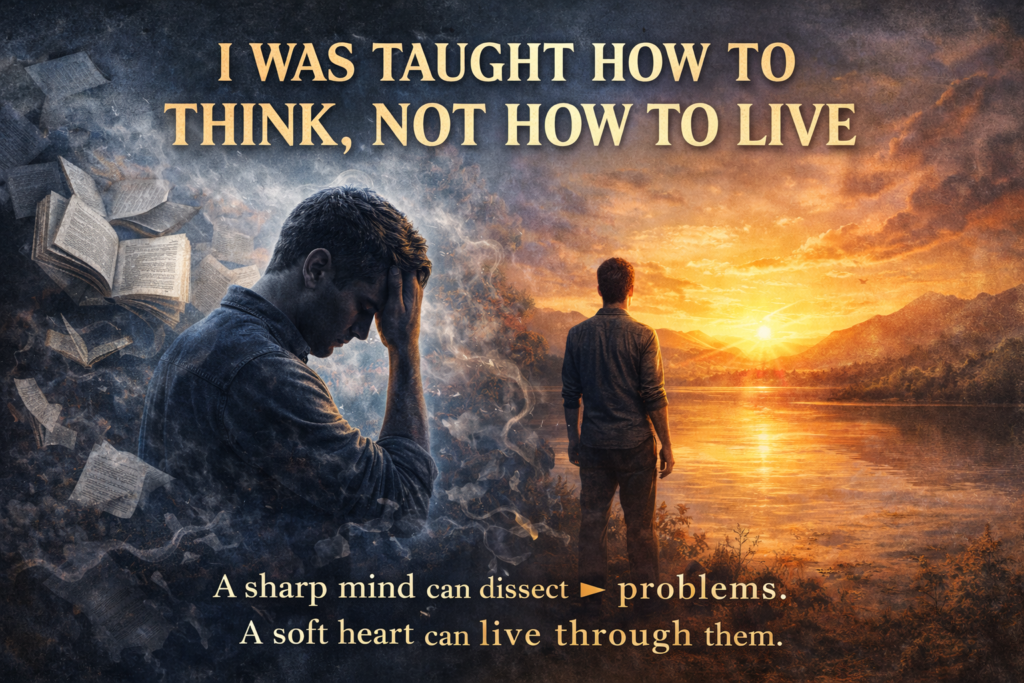
I could take a messy idea and straighten it out.
I could enter a conversation and win it.
I could dissect a problem until it lay open and defenseless.
Teachers praised it. People admired it. I admired it too.
Clarity felt like power.
But no one warned me that a sharp mind, left unchecked, can turn inward.
And when it does, it doesn’t solve life.
It interrogates it.
The Education of the Mind and the Neglect of the Self
Modern education trains us to analyze, compare, defend, conclude. We are rewarded for certainty, speed, and articulation. Hesitation looks weak. Silence looks unprepared.
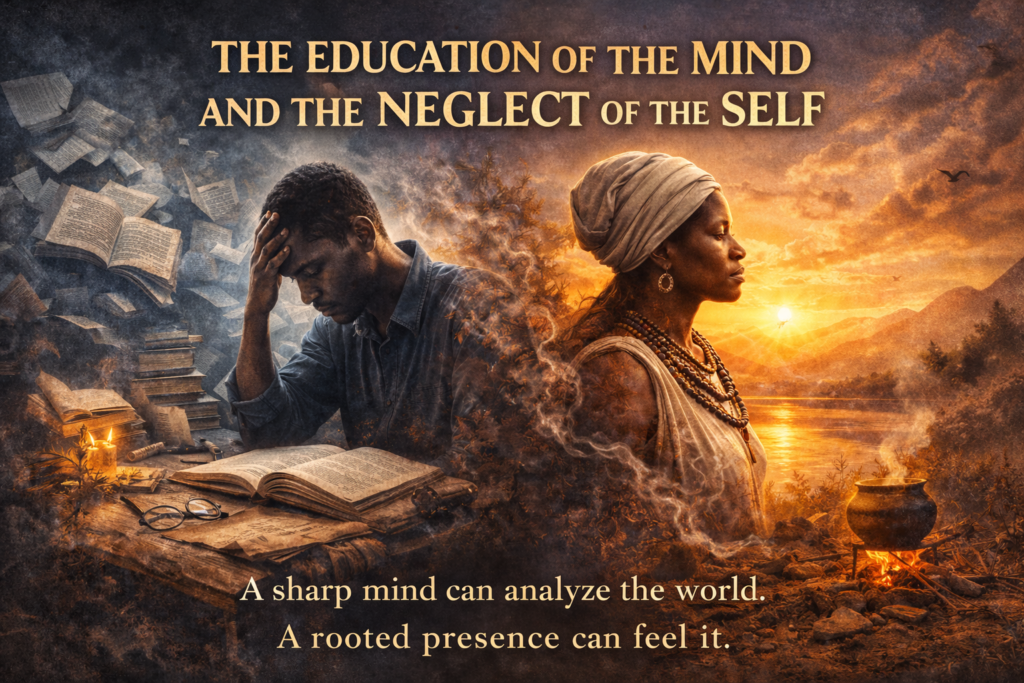
So we build identities around being “the one who understands.”
But life does not present itself as a debate.
It arrives as grief that doesn’t follow logic.
As love that refuses to be categorized.
As timing that doesn’t match our plans.
As silence where answers should be.
And suddenly, all that thinking feels strangely useless.
The Anxiety Beneath Intelligence
Here is something I had to admit slowly:
A lot of my thinking was not curiosity.
It was control.
When I overanalyzed conversations, I wasn’t being insightful; I was trying to avoid rejection.
When I obsessed over decisions, I wasn’t being responsible; I was trying to eliminate regret.
When I searched for the “right” answer to life, I wasn’t being wise; I was afraid of uncertainty.
Thinking felt productive.
But often, it was just the fear of wearing academic clothing.
When Thought Turns Against You
There is a quiet threshold most of us cross without noticing.
At first, thinking helps.
Then it begins to repeat.
Then it begins to amplify.
Then it begins to exhaust.
You replay the same scenario.
You rehearse the same future.
You construct imaginary outcomes.
Nothing resolves. The mind grows louder.
And because you were trained to trust thought above all else, you assume the solution must be… more thought.
It rarely is.
A Different Way of Seeing
When I encountered the writings associated with the Tao Te Ching, attributed to Laozi, I expected arguments. Frameworks. Clear systems.
Instead, I found something unsettling.
The text does not rush to solve.
It does not insist.
It does not push.
It keeps pointing back to something simple and almost uncomfortable:
Stop forcing.
Not because effort is bad.
But because not everything requires it.
The Taoist idea of wu wei, often translated as effortless action, isn’t laziness. It’s alignment. It’s knowing when pushing distorts what would otherwise unfold naturally.
That idea disturbed my training.
Because my training taught me that progress equals pressure.
The Intelligence of Restraint
Watch a river. It moves around rocks without arguing with them.
Watch a tree. It grows without announcing its strategy.
There is an intelligence in nature that does not look like effort. It looks like timing.
Not every discomfort is a problem to fix.
Not every confusion is a failure.
Not every delay is an error.
Some things ripen only when left alone.
The mind, however, dislikes waiting. It calls patience “waste.” It calls surrender “weakness.”
But sometimes restraint is not weakness. It is precision.
The Hard Work of Unlearning
Learning adds layers to who you are.
Unlearning removes them.
When I stopped trying to have immediate answers, something strange happened. I felt exposed. Less impressive. Less certain.
I could no longer rely on being the smartest voice in the room.
But I also felt lighter.
I began to notice how much energy I had spent managing outcomes that were never fully mine to control. I began to see how often I confused explanation with peace.
They are not the same.
You can explain your anxiety perfectly and still feel anxious.
You can understand your grief intellectually and still need to sit with it quietly.
Thought can describe life.
It cannot replace living it.
What Living Actually Feels Like
Living, I am learning, is slower than thinking.
It involves:
- Letting conversations breathe without rehearsing them afterward.
- Allowing decisions to settle instead of squeezing them for certainty.
- Sitting with discomfort without immediately diagnosing it.
It feels less dramatic than analysis.
Less impressive.
But more real.
There is a softness in saying, “I don’t know yet.”
There is strength in saying, “This doesn’t need fixing.”
There is maturity in waiting.
A Different Definition of Intelligence
We have been taught that intelligence is sharpness, the ability to cut through confusion quickly.
But perhaps there is another form.
An intelligence that knows when to stop cutting.
An intelligence that trusts process over panic.
An intelligence that allows life to unfold without constant interference.
This kind of wisdom does not announce itself.
It does not argue.
It does not perform.
It simply rests.
And from that rest, clearer action eventually emerges, not forced, not frantic, not defensive.
Just timely.
A Final Thought
Maybe the goal is not to think less.
Maybe it is to trust more.
To trust that not every silence needs filling.
Not every feeling needs explanation.
Not every future need rehearsing.
If you have spent years sharpening your mind, perhaps the next quiet revolution is softening your grip on it.
What would happen if, just for a moment, you stopped trying to solve your life and simply allowed it to unfold?
Not as a surrender.
But as participation.
Not as passivity.
But as presence.
Maybe the question is not, “What should I think next?”
Maybe it is, “What would it feel like to live, even briefly, without forcing the answer?”
And maybe that experiment is waiting for you, the next time your mind begins to race.
Will you pause long enough to try?