

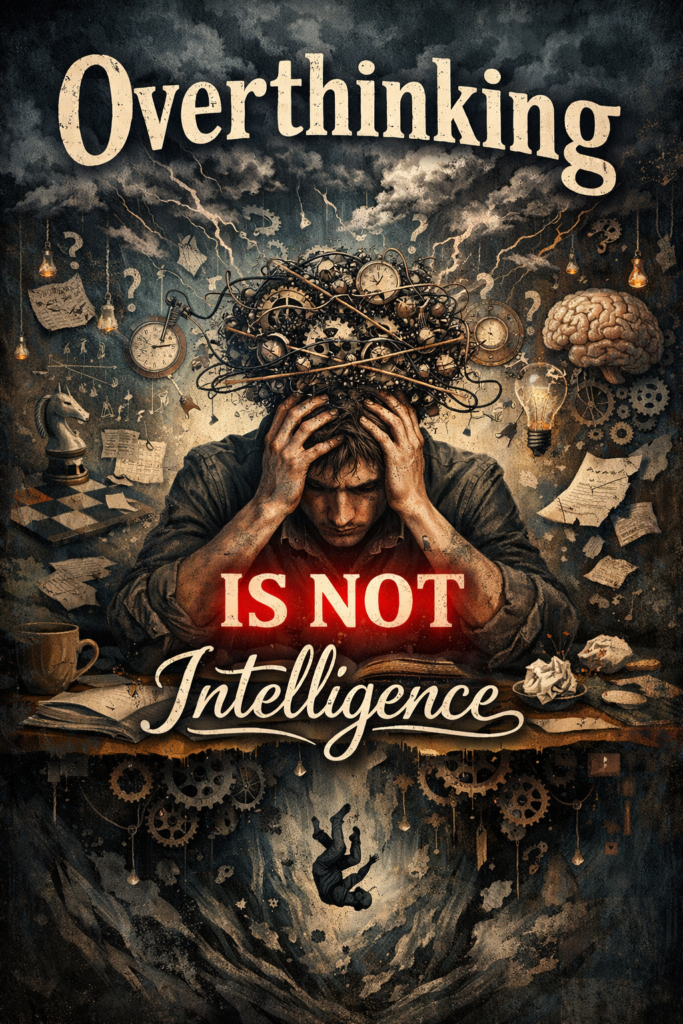
There was a time I thought my exhaustion meant I was deep.
If my mind never stopped, if I could analyze every angle, predict every outcome, rehearse every possible conversation, I assumed that meant I was intelligent.
But no one tells you this:
A constantly racing mind is not proof of depth.
Sometimes it is proof of fear.
Recognition
I began noticing something uncomfortable.
The people I admired most were not the ones mentally spiraling over every detail. They were steady. Present. Decisive. Quiet in a way that didn’t feel empty.
Meanwhile, I was tired.
Not physically.
Mentally tired. And I had mistaken that fatigue for intellectual seriousness
Emotional Honesty
Let me admit something I rarely say out loud:
Overthinking made me feel superior.
It gave me a private narrative, “I see more. I think more. I go deeper than others.”
But if I’m honest, much of it was just looping.
Replaying.
Imagining disasters.
Trying to control outcomes that hadn’t even happened.
That isn’t intelligence.
That’s anxiety wearing academic clothing.
1. The Exhaustion of Thinking
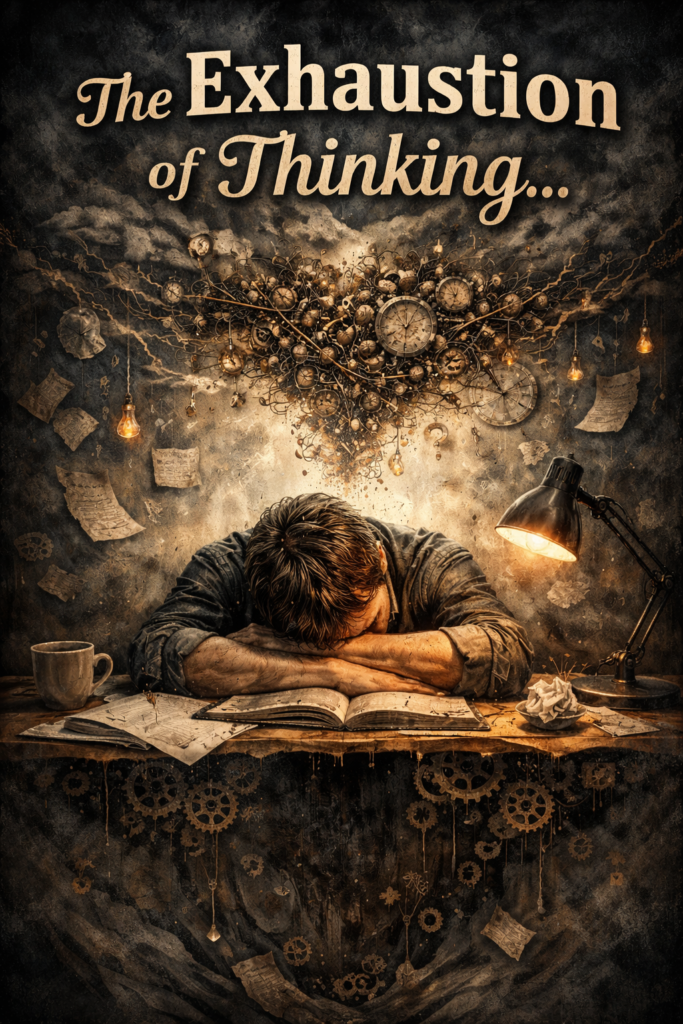
There is a specific kind of exhaustion that comes from overthinking.
It’s not the tiredness of hard work.
It’s the tiredness of mental resistance.
You think about a conversation ten times before it happens.
You analyze a decision long after it’s already made.
You mentally argue with people who are not even present.
And your body feels it.
Your shoulders tighten.
Your sleep becomes shallow.
Your joy becomes delayed, always postponed until “certainty” arrives.
But certainty never comes.
Only more thinking.
2. How Overthinking Is Praised
We live in a culture that quietly rewards mental hyperactivity.
If you hesitate, you are “careful.”
If you analyze endlessly, you are “thorough.”
If you struggle to decide, you are “considering all dimensions.”
But there is a difference between reflection and rumination.
Reflection moves you forward.
Rumination keeps you trapped in the illusion of productivity.
I used to believe that the more complicated my internal process was, the smarter I must be.
But complexity is not the same as clarity.
Sometimes it is just noise.
3. The Fear Beneath It
When I slowed down enough to observe my thinking, I noticed something unsettling:
Most of it was fear-driven.
Fear of being misunderstood.
Fear of making the wrong move.
Fear of losing control.
Fear of regret.
Overthinking wasn’t brilliance.
It was self-protection.
My mind believed that if it could simulate every scenario, I could avoid pain.
But life does not reward mental simulations.
It rewards presence.
And presence requires vulnerability.
4. When Thinking Stops Helping
Thinking is powerful. It builds civilizations. It creates art. It solves problems.
But there is a moment when thinking stops helping.
You know it when:
You are no longer gathering information — you are rehearsing fear.
You are no longer solving — you are stalling.
You are no longer discerning — you are doubting yourself into paralysis.
There is a subtle shift where intelligence turns into interference.
The mind begins interrupting life instead of engaging it.
I have crossed that line more times than I can count.
And every time, action — even imperfect action — brought more clarity than hours of analysis ever did.
5. What Non-Interference Feels Like
The first time I consciously stopped interfering with my own thoughts, it felt almost irresponsible.
Shouldn’t I be thinking this through more?
Shouldn’t I anticipate what could go wrong?
But something surprising happened.
When I allowed situations to unfold without mentally controlling them, my body softened.
Conversations flowed more naturally.
Decisions felt lighter.
Mistakes became survivable.
Non-interference does not mean carelessness.
It means trusting that intelligence is not constant mental commentary.
Sometimes intelligence is silence.
6. A Different Way to Measure Intelligence
What if intelligence is not measured by how much you think —
but by how little thinking you need?
What if clarity is the ability to see without distortion?
What if wisdom is knowing when to stop?
I have met people with extraordinary academic achievements who are tormented by their own minds.
And I have met simple, grounded individuals whose presence feels like stability itself.
Maybe intelligence is not volume.
Maybe it is alignment.
Not the loudness of thought,
but the quiet confidence of awareness.
Final Reflection
I no longer admire my own mental chaos.
I am learning to admire stillness.
Not because I have stopped thinking,
but because I have stopped worshipping thought.
There is something deeply freeing about realizing:
You do not have to mentally wrestle with life to understand it.
Sometimes, the most intelligent thing you can do
is step aside
and let reality breathe.
And in that space,
without forcing,
without rehearsing,
without proving
There is a different kind of clarity.
One that does not exhaust you.