


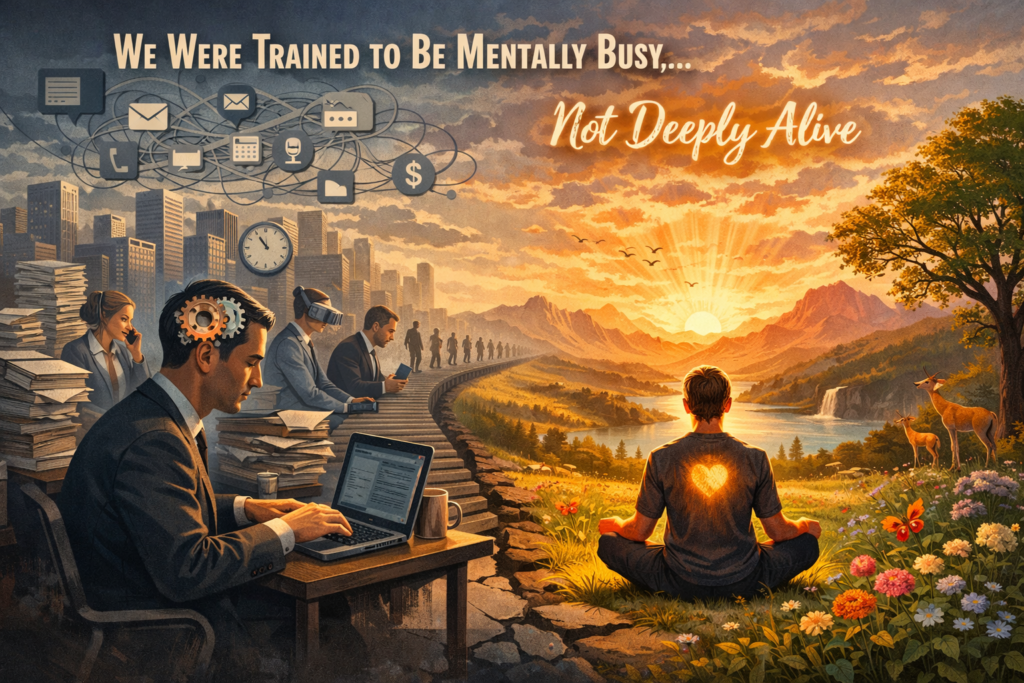
- There is a strange exhaustion many people carry today.
- Not physical.
- Not even emotional.
- It is a fatigue of mental posture. We wake up already thinking.
- We go to bed still processing.
Our minds rarely rest, not because life is demanding, but because we were never taught how to stop managing reality in our heads.
What makes this exhaustion difficult to name is that it often disguises itself as intelligence.
We are tired, yet articulate.
Overwhelmed, yet informed.
Anxious, yet analytical.
And so we assume the problem is life itself.
But what if it’s not?
1 . The Invisible Training No One Talks About
Most of us were educated to think about life, not to be inside it.
From a young age, we learned that clarity is safety.
That answers are progress.
That uncertainty is something to overcome quickly.
We were rewarded for:
- Explaining ourselves
- Justifying our feelings
- Having reasons for everything
- Turning experience into language

Slowly, almost politely, we were trained to stand above life rather than within it.
And we called this maturity.
But something subtle was lost along the way.
2. When the Mind Becomes a Supervisor of Life
At some point, many people notice an odd split inside themselves.
Life happens — and then the mind immediately evaluates it.
A moment of sadness appears, and the mind asks why.
A sense of joy arises, and the mind wonders how long it will last.
A difficult decision comes, and the mind runs endless simulations.
Nothing is allowed to simply be.
We don’t live moments anymore.
We manage them.
And management is tiring.
This is not because the mind is bad.
It’s because the mind was trained to supervise everything — even what doesn’t need supervision.
3. The Fear Beneath Overthinking

Overthinking is often described as a personality trait or a mental health issue.
But for many people, it is something else entirely.
It is fear disguised as responsibility.
Fear of making the wrong move.
Fear of wasting time.
Fear of not understanding fast enough.
Fear of being unprepared.
So the mind works overtime.
It analyzes because it doesn’t trust life.
It plans because it doesn’t trust timing.
It explains because it doesn’t trust experience.
This constant mental effort is praised in modern culture.
We call it being “on top of things.”
But the body feels the cost.
4. A Quiet Realization That Changes Everything
At some point — often during burnout, loss, or stillness we didn’t choose — a realization appears:
Thinking harder isn’t helping anymore.
Not dramatically.
Not suddenly.
Just quietly.
- The same thoughts repeat.
- The same clarity fails to bring peace.
- The same understanding doesn’t translate into ease.
And a disturbing question surfaces:
What if the way I’ve been taught to use my mind is part of the problem?
This question is unsettling because it has no immediate answer.
And that is precisely why it matters.
The Forgotten Skill: Not Interfering
There is a form of intelligence that rarely gets named.
It is the intelligence of not interfering.
You see it in nature:
- Rivers don’t hurry
- Seasons don’t debate
- Growth doesn’t overexplain itself
Life unfolds without commentary.
But humans were taught that absence of commentary is ignorance.
So we narrate everything.
We interpret constantly.
We live in explanations rather than experience.
What if intelligence also includes knowing when to step back?
What if wisdom sometimes means:
- Not responding immediately
- Not forming an opinion yet
- Not fixing what isn’t broken
- Not forcing clarity before its time
This is not passivity.
It is restraint.
And restraint is rare.
5. Why Silence Feels So Uncomfortable Now
Many people say they dislike silence.
But what they really dislike is what silence reveals.
Silence exposes:

- Unresolved tension
- Unprocessed emotion
- The absence of control
When there is no noise, the mind loses its job.
And that feels threatening.
Yet silence is not emptiness.
It is space.
Space where life can move without being directed.
Space where clarity arrives organically.
Space where the body remembers how to breathe.
The discomfort we feel in silence is often withdrawal — not from stimulation, but from control.
6. Unlearning Is Not Regression
There is a misunderstanding that letting go of excessive thinking means becoming less intelligent.
In reality, something opposite happens.
The mind becomes available instead of busy.
Attention becomes present instead of scattered.
Action becomes appropriate instead of forced.
You still think.
You just don’t panic-think.
You still plan.
You just don’t cling to outcomes.
You still analyze.
But only when analysis serves life — not when it replaces it.
This is not a loss of intelligence.
It is intelligence maturing beyond anxiety.
7. A Different Measure of a Good Life
We often measure a good life by:
- Achievement
- Productivity
- Understanding
- Control
But there is another measure, quieter and more honest:
How much effort does it take for you to exist inside your own life?
A life that requires constant mental management is not a peaceful one — even if it looks successful.
A life that allows room for not-knowing, pauses, and natural rhythm feels lighter — even if it appears ordinary.
And perhaps ordinary is not a failure.
Perhaps it is a relief.
Returning Without Going Back
This is not about rejecting thought.
It is about rebalancing it.
The mind was meant to be a tool, not a supervisor.
A helper, not a ruler.
A guide, not a guard.
When thinking returns to its rightful place, something softens.
Life feels less like a project.
Moments feel less urgent.
You begin to trust timing again.
Not blindly.
But gently.
Final Reflection
If you feel mentally exhausted despite understanding so much…
If clarity hasn’t brought peace…
If thinking feels loud instead of helpful…
You are not broken.
You are overtrained in one direction.
And learning to loosen that training is not weakness.
It is a return.
Not to ignorance.
But to a quieter, deeper form of intelligence — one that knows when to think, and when to let life move on its own.
Have your own say……