


What if the version of African history many of us inherited was written by people who were afraid?
Not afraid of chaos.
Afraid of losing power.
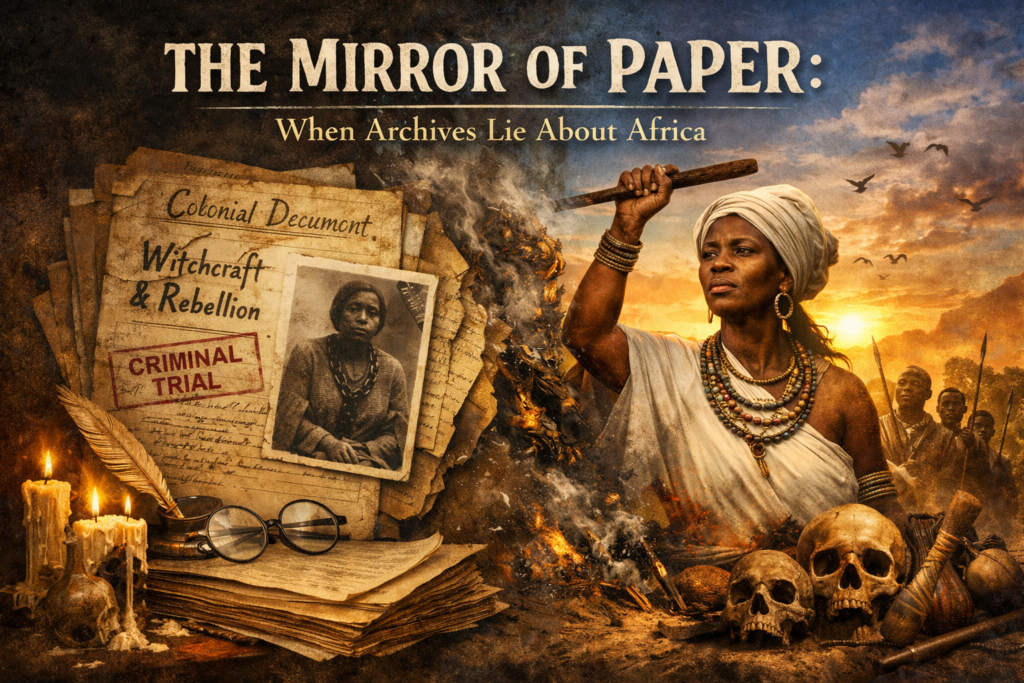
When you read colonial records about African resistance leaders, something feels… off. The tone is cold. The language is sharp. The judgment is already decided before the story even begins. Leaders are labeled “rebels.” Spiritual authorities become “witches.” Resistance becomes “criminality.”
And suddenly, you realize: this is not just history.
This is power speaking.
The Case of Nehanda Charwe Nyakasikana
If you read colonial trial documents about Nehanda, the story sounds simple. A woman accused of murder. Tried. Executed. Case closed.
But history is rarely that neat.
Nehanda was not simply an individual standing in isolation. She was a spirit medium within Shona society, a moral and spiritual authority. Her resistance emerged in the context of land theft, forced labor, cultural humiliation, and violent colonial expansion in what is now Zimbabwe.
Yet the colonial archive strips all of that away.
Instead of a spiritual leader defending her people, she becomes a criminal. Instead of resistance to injustice, her actions are framed as irrational rebellion. Instead of moral courage, the documents offer disorder.
The trial itself reads less like justice and more like performance. The empire needed to prove it was in control. It needed a symbol to crush. Nehanda became that symbol.
The medium becomes a murderer.
The defender becomes the threat.
And on paper, the empire wins.
Archives Are Not Neutral
We like to imagine archives as quiet rooms filled with objective truth. But archives are built by someone. Collected by someone and preserved by someone.
And in colonial contexts, that “someone” was the colonizer.
Every word in those reports served a purpose. Words like:
- “Superstition”
- “Savage”
- “Witchcraft”
- “Rebellion”
These are not neutral descriptions. They are tools. They shape how future generations understand African societies.
The archive does not just record events.
It decides who is legitimate and who is disposable.
When you read closely, you begin to notice the silences. There is no serious attempt to understand African spiritual frameworks. No effort to grasp community structures. No curiosity about moral reasoning outside European logic.
What is missing speaks as loudly as what is written.
“Her Bones Will Rise Again”
Colonial writers mocked the prophecy associated with Nehanda: “Her bones will rise again.”
To them, it sounded mystical. Primitive. Absurd.
But within Shona understanding, bones are not just remains. They represent continuity, ancestral presence, moral memory. Death is not disappearance. It is transformation.
The archive could not translate that worldview. So, it dismissed it.
But history has a strange way of correcting itself. Decades later, Nehanda became a powerful symbol in Zimbabwe’s liberation struggle. The prophecy, once mocked, became metaphor and memory.
The bones did rise again, not physically, but politically and spiritually.
And the colonial papers could not stop that.
Why This Still Matters
This isn’t just about the past.
When young Africans grow up reading history that describes their heroes as criminals and their spirituality as superstition, something subtle happens. Identity bends. Confidence erodes. Pride becomes complicated.
Narratives shape nations.
If we accept colonial records without question, we inherit their bias. But if we read critically, if we ask who wrote this, and why, we begin to recover something powerful.
We begin to see African leaders as thinkers. Strategists. Spiritual authorities. Moral agents.
Not caricatures.
Reading Against the Grain
You don’t need to stand inside an archive building to see this distortion. It appears in the tone. In the omissions. In the language of judgment.
To read colonial history well, you must read it twice:
- First, for what it says.
- Then, for what it hides.
Consult oral histories. Listen to community memory. Pay attention to cultural logic. Compare perspectives.
Truth often lives in the margins.
Reclaiming the Story
Figures like Nehanda were not passive subjects of history. They were active participants in shaping it. They made choices. They led communities. They resisted injustice.
The colonial archive tried to freeze them in a single frame, criminal, rebel, fanatic.
But history is larger than paper.
The real story lives in songs, in land, in memory, in spirit.
And perhaps the most powerful act today is not rewriting history, but reading it differently.
Because sometimes the archive is not a mirror of truth.
It is a mirror of fear.
And when we recognize that, we begin to see clearly again.